7 Germany Visa Rejection Reasons You Haven't Thought of (And How to Fix Them)
Discover the 7 overlooked Germany visa rejection reasons that most applicants miss. From generic SOPs to bank account errors, learn how to fix them and secure your visa in 2025.
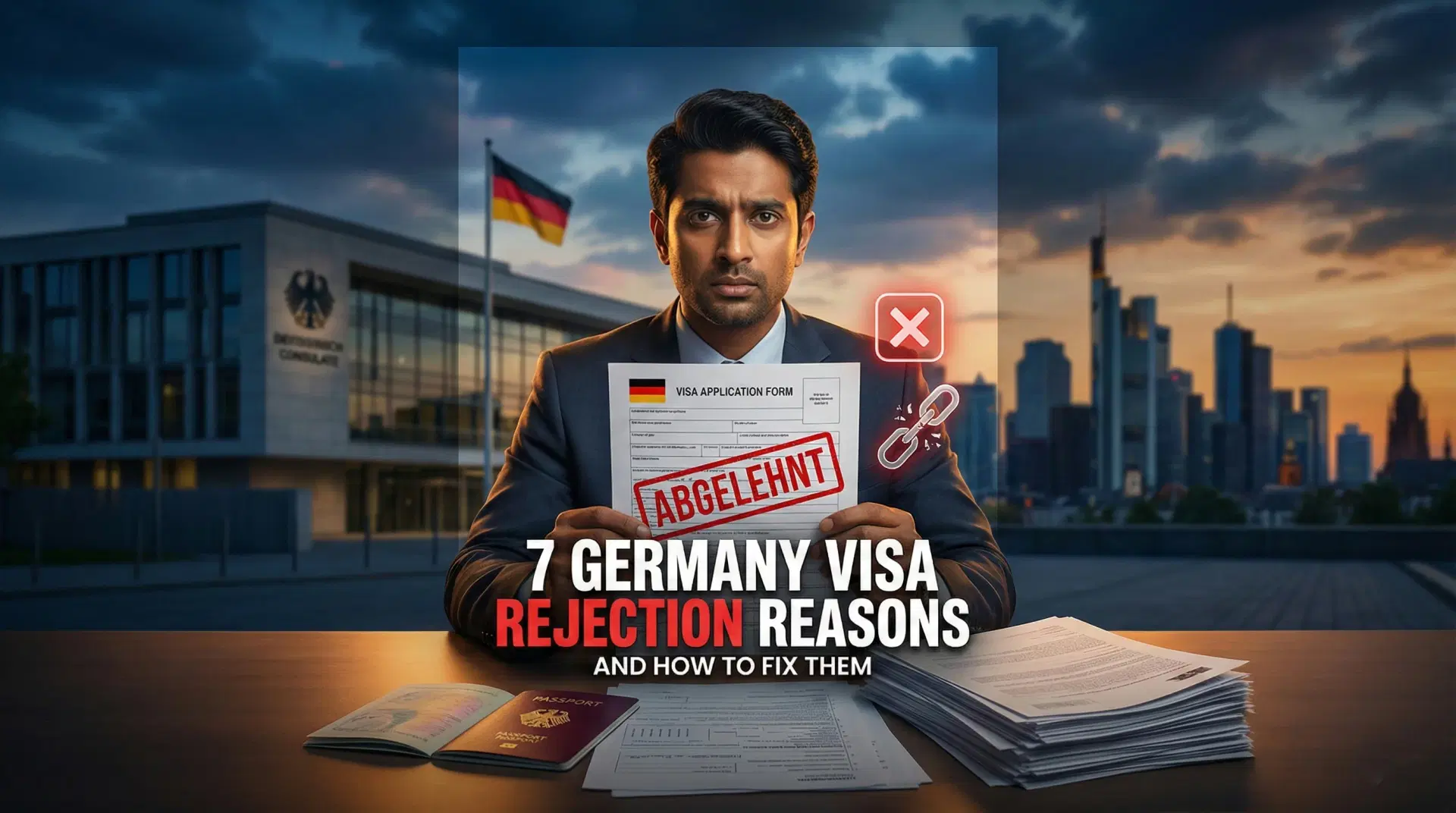
Receiving a rejection stamp on your passport is a devastating feeling. You spent months gathering documents, paid significant fees, and mentally prepared for your new life in Berlin or Munich - only to be told “No.” What makes it worse is the standard refusal letter, which often cites generic clauses like “doubt about purpose of stay” or “insufficient proof of funds” - leaving you confused. The truth is, German consular officers are trained to look for patterns and inconsistencies that are not on the official checklist. This guide digs into the subtle Germany visa rejection reasons most applicants ignore until it is too late - and gives you the specific fixes for each one.
Understanding the “Hidden” Germany Visa Rejection#
Reasons
Most applicants obsess over the obvious requirements - a valid passport, the right photo size, and the application fee. While mandatory, these are rarely the cause of a rejection. Refusals almost always happen in the grey areas: the qualitative assessment of your intent, your history, and your future potential.
1. The “Generic Motivation” Trap#
A motivation letter (or Statement of Purpose) is required for almost all long-term German visas - Student, Job Seeker, and Opportunity Card. The mistake most people make is writing a letter that could apply to anyone.
The rejection trigger: If your letter says, “I want to come to Germany because it has a strong economy, beautiful castles, and good cars” - you are at risk. The visa officer reads this hundreds of times a day. It signals a lack of genuine research. Worse, if your motivation does not logically connect your past (education or experience) to your future in Germany, the officer will assume you simply want any route into Europe.
The fix: Your motivation must be hyper-specific.
- ❌ “I want to study engineering.”- ✅ * “My background in mechanical systems in Sri Lanka revealed a gap in my knowledge regarding sustainable automation. Germany's Industry 4.0 initiative, specifically the curriculum at [University Name], directly addresses this gap.” * Connect the dots clearly:Past → Gap → Germany → Future Solution.## 2. “Window Dressing” Your Bank Account Everyone knows about the Blocked Account (Sperrkonto). But for many visas you also need to show current bank statements - and these reveal a pattern, not just a snapshot.The rejection trigger: If your balance was consistently low for five months and then a large deposit appears two weeks before your appointment, the embassy suspects this is borrowed money staged specifically for the application. It is one of the most common Germany visa rejection reasons - and one of the easiest to trigger accidentally.
The fix:- Build a history - maintain a steady balance for 3–6 months before your application - Explain the source - if you receive a large sum (property sale, parental gift), attach an affidavit or proof of transaction explaining exactly where it came from. Transparency completely neutralises the flag ## 3. The “Academic Mismatch” (The Logic Gap) This is a frequent heartbreaker for student visa applicants. You have the admission letter from a German university - you think you are safe. Not necessarily.The rejection trigger: The visa officer has the right to assess the plausibility of your studies. If you hold a Bachelor's in History and are applying for a Master's in Data Science without relevant experience or bridge courses, the officer may conclude that you will struggle to complete the programme and are likely to drop out and work illegally - even if the university accepted you.
The fix: Bridge the gap explicitly in your Motivation Letter. Explain why you are pivoting careers. Reference online certifications, internships, or specific modules in the German programme that provide a structured on-ramp. Prove you are academically prepared to survive the rigorous German education system.
4. Inconsistent CV Dates vs. Application Dates#
German bureaucracy operates on precision. A common silent killer is a discrepancy between documents that the applicant never notices.
The rejection trigger: Consider this scenario:
- Your Visa Application Form says you worked at Company X from Jan 2022 to Dec 2022
- Your CV says Jan 2022 to Present- Your Experience Letter says Jan 2022 to Nov 2022 These small errors suggest carelessness or dishonesty. In the eyes of the embassy: untrustworthy documents = untrustworthy applicant.The fix: Conduct a forensic audit of your own application. Lay your CV, VIDEX application form, and experience letters side by side and cross-check every single date. If you have an employment gap, do not hide it - label it clearly as “Sabbatical,” “Freelancing,” or “Language Learning.”
5. The “Schengen Shopping” Suspicion#
This applies if you have recently applied for visas to other European countries.
The rejection trigger: Germany is part of the VIS (Visa Information System) - they can see your entire application history. If you applied for a tourist visa to France last month and were rejected, and now you are applying for a language student visa to Germany, the officer may read this as “visa shopping”
- the conclusion being that you do not genuinely care about Germany and just want to enter the Schengen zone by any means.
The fix: Address the previous rejection directly in your cover letter. Explain clearly why your circumstances have changed or why Germany is your genuine destination. Do not attempt to hide a prior refusal - the system already shows it, and not addressing it looks like concealment.
6. Insufficient “Rootedness” - The Return Intent Problem#
For short-stay visas and some job-seeker visas, the embassy needs to believe you will eventually return home.
The rejection trigger: If you are young, unmarried, own no property, have no job in your home country, and have no family dependants - you fit the profile of a potential overstayer. This is one of the hardest Germany visa rejection reasons to counter because it is based on your demographic profile, not a document error.
The fix: Prove social and economic ties to Sri Lanka proactively - even if not explicitly asked.
- Economic ties - property deeds, business registration, or a letter from your current employer confirming a role waiting on your return
- Social ties - marriage certificate, birth certificates of children, or evidence that you are the primary carer for elderly parents
Attaching a brief “Return Intent” statement can tip the scales - even when it is technically optional.
7. The “Dummy Booking” Disaster#
Many applicants use dummy flight tickets or hotel reservations that auto-cancel after 48 hours to save money during the application process.
The rejection trigger: Consular staff do spot checks. If they call the hotel listed on your application and the hotel says the reservation was cancelled, your credibility is destroyed. It looks like fraud. Similarly, if your travel health insurance start date does not align with your flight date, it is an automatic technical rejection.
The fix:- Accommodation - use “Pay at Hotel” options on reputable sites (Booking.com) that keep the reservation active throughout the processing period, or obtain a formal invitation letter from a host in Germany - Insurance - ensure your health insurance covers the entire duration of your initial stay and meets the minimum €30,000 coverage requirement. For students, Incoming Insurance (Expat Insurance) is often safer than standard travel insurance ## Three Strategies to Prevent Rejection Before It Happens ### 1. The Four-Eye Principle Never submit your application without a second pair of eyes reviewing it. After weeks of working on forms, you become blind to your own inconsistencies. A professional or meticulous colleague cross-checking your dates and spellings catches what you miss. ### 2. Know Your Own Story for the Interview Document submission sometimes includes a brief interview. If your Motivation Letter says you want to study Automotive Engineering but you cannot name a single German car manufacturer or explain why you chose TU Munich over RWTH Aachen, your application can fail right there at the counter. Prepare to speak confidently about every claim in your application file. ### 3. Organise Your Document Stack Logically Do not hand over a disorganised pile of papers. Order your documents exactly as listed on the embassy checklist. Highlight key figures - salary, savings, coverage amounts - clearly. A well-organised file makes the visa officer's job easier, and that goodwill is not insignificant. ## If You Have Already Been Rejected A rejection is not the end of the road. You have the right toRemonstrate (formally appeal the decision) within one month. This involves writing a detailed legal letter that addresses the specific rejection reason cited and provides new evidence to counter it.
However, prevention is always the stronger strategy. The German bureaucratic process rewards preparation, not improvisation.
How Glück Global Protects Your Application#
- Forensic document audit - we cross-check your CV, experience letters, VIDEX application, and financial proofs to identify and eliminate inconsistencies before submission
- Motivation letter and SOP drafting - our experts build a compelling, specific narrative that connects your background directly to your German pathway in a way that satisfies consular assessment
- Mock interview preparation - we prepare you for the exact questions German Embassy staff are likely to ask, so you arrive confident and coherent
- Rejection analysis and re-application - if you have already been refused, we analyse your full file to identify precisely what went wrong and build a corrected, stronger re-application
Your German dream is too important to risk on a small, avoidable mistake. Contact Glück Global to get your application right the first time →
Frequently Asked Questions#
What is the most common reason for a German visa rejection?
The most common underlying reason - beyond surface document issues - is a failure to demonstrate genuine, specific intent. Generic motivation letters, unexplained financial spikes, and date inconsistencies across documents are the most frequent patterns Glück Global identifies in rejected applications. The official refusal letter often says “doubt about purpose of stay,” but the real cause is usually one of the seven issues covered in this guide.
Can I re-apply after a German visa rejection?
Yes. You can submit a formal Remonstration (appeal) within one month of the rejection, or re-apply once the identified issues have been resolved. Re-applying without fixing the root cause of the original rejection typically results in a second refusal. Glück Global's rejection analysis service identifies the exact cause and builds a corrected file for re-submission.
Does a previous visa rejection to another Schengen country affect my
German visa application?
Yes - Germany has access to the Schengen Visa Information System (VIS), which shows your full application history including rejections from other member states. You must address any prior rejection proactively in your cover letter. Attempting to conceal a previous refusal when the consular officer can already see it is one of the fastest ways to be rejected again.