Anerkennungsprozess: How to Get Your Sri Lankan Qualifications Recognized in Germany
The Anerkennungsprozess is Germany's official qualification recognition procedure. Complete guide for Sri Lankans - regulated vs. non-regulated professions, step-by-step process, costs, and timelines.
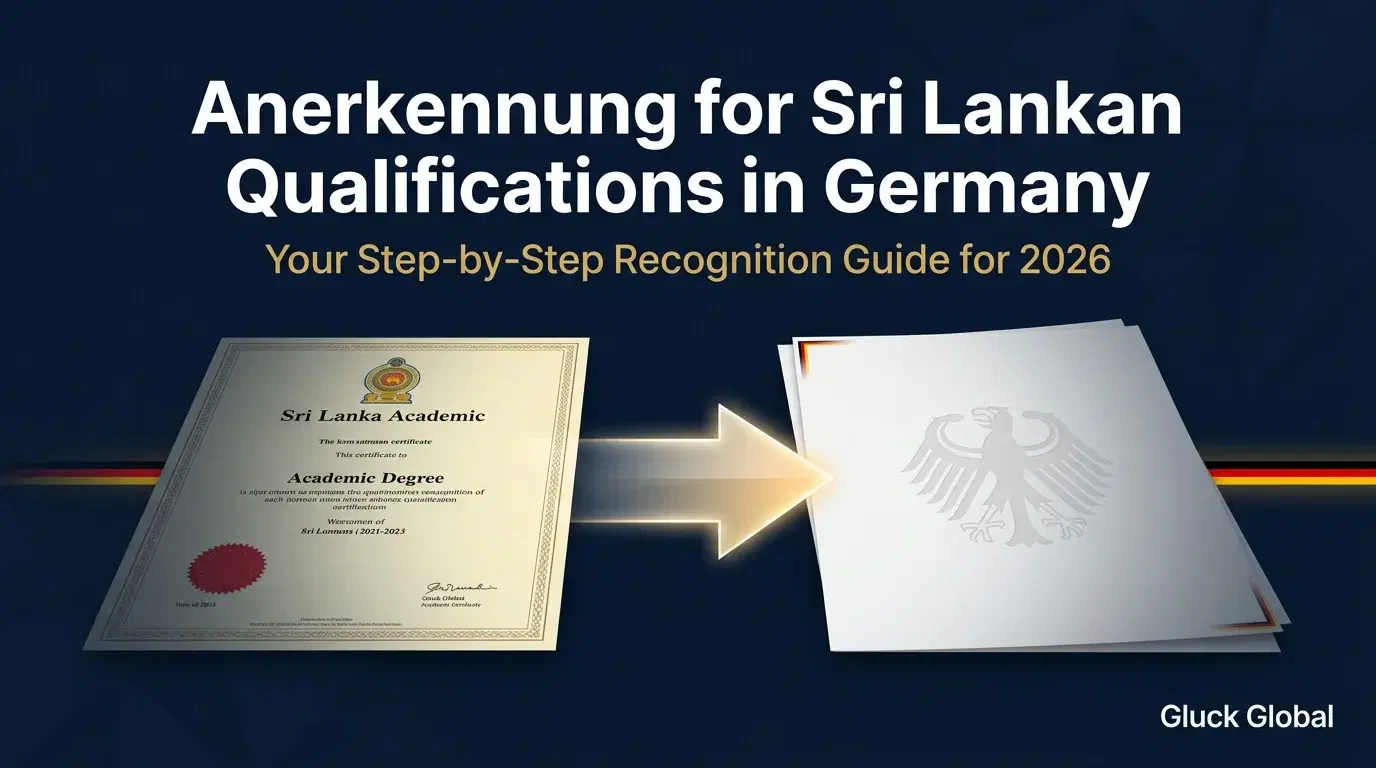
The Anerkennungsprozess (recognition procedure) is the official German process that compares your Sri Lankan qualification to an equivalent German one. It is required before you can use your professional qualification to work in Germany in most regulated professions, and it directly affects your eligibility for the Opportunity Card, EU Blue Card, and skilled worker visa. The process typically takes 3–4 months once all documents are submitted.
Why Recognition Matters#
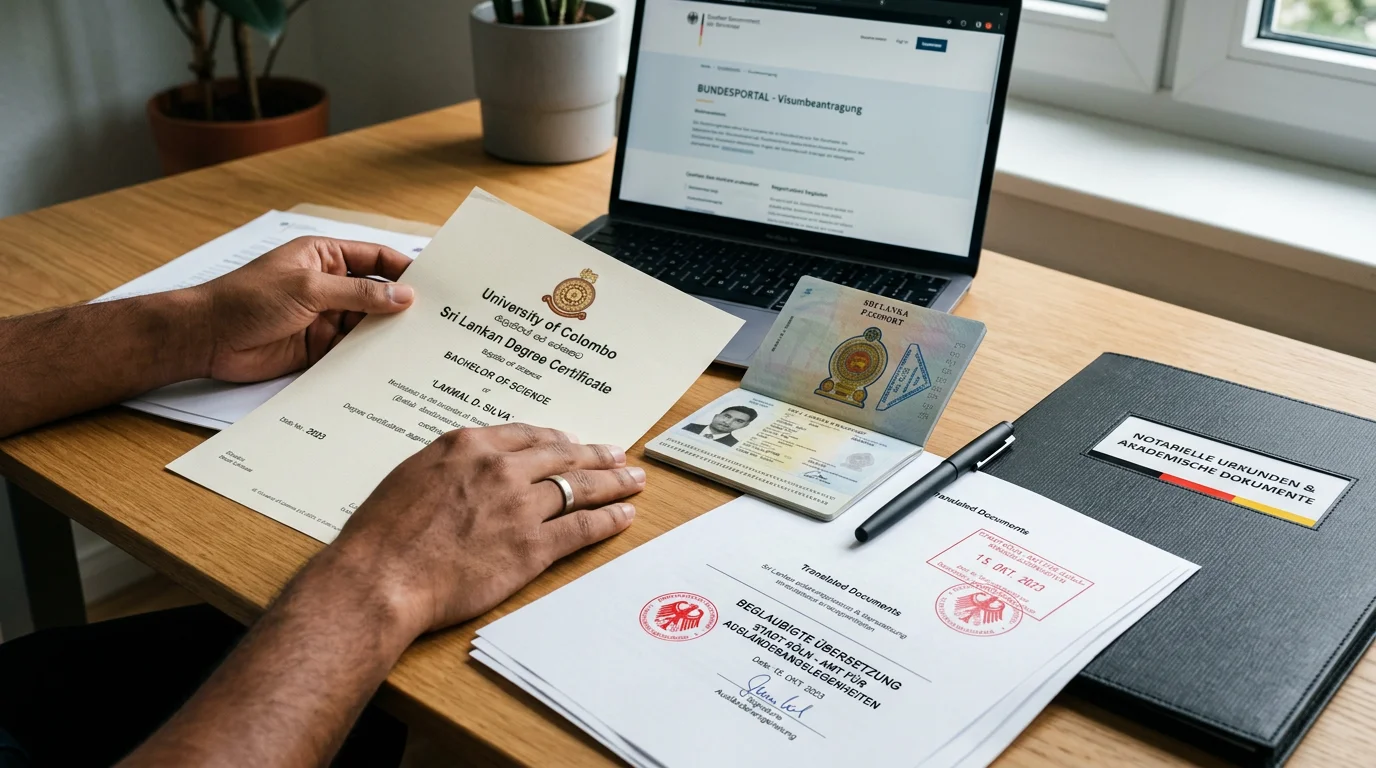
*Keep your academic certificates, translations, and notarized documents organized - a complete file speeds up your Anerkennung review.*Germany does not automatically accept foreign degrees and vocational certificates as equivalent to German qualifications. Whether you trained as a nurse, engineer, IT specialist, teacher, or accountant, the German authority (Zuständige Stelle) for your profession will assess whether your education matches German standards in content and duration. ### Without recognition: - You may be unable to legally practise in regulated professions (healthcare, law, teaching) - Your Opportunity Card points will be lower (no recognition = fewer points) - Your salary and job title may be restricted ### With full recognition: - You work on equal footing with German-trained professionals - You qualify for higher salary scales - Your visa application is significantly stronger ## Regulated vs. Non-Regulated Professions | Category | Examples | What Recognition Means | | --- | --- | --- | | Regulated professions | Nurse, doctor, dentist, pharmacist, architect, teacher | Must have recognition before practising | | Non-regulated professions | IT specialist, engineer (most), business administrator, accountant | Recognition improves opportunities but is not legally mandatory | For non-regulated professions, you can often work without formal recognition - but employers may still require proof of equivalence, and your visa application is stronger with it. ## The Recognition Procedure: Step by Step ### Step 1: Identify Your Competent Authority Use the online tool at anerkennung-in-deutschland.de to find the specific German authority (Zuständige Stelle) for your profession and target federal state. ### Step 2: Submit Your Documents Standard documents required: - Certified copy of your qualification certificate - Official transcript of studies or training - Curriculum vitae (Lebenslauf) - Proof of practical experience (if applicable) - German translation of all documents (by a certified translator) - Copy of passport For vocational qualifications: IHK FOSA (Foreign Skills Approval) handles most non-academic assessments. For academic degrees: ZAB (Central Office for Foreign Education) issues statements of comparability. ### Step 3: The Equivalence Assessment The authority compares your Sri Lankan qualification against the German reference occupation. Processing takes3–4 months after all documents are received.
Step 4: Receive Your Result
- Full recognition: Your qualification is fully equivalent - you can work at the same level as German-trained professionals
- Partial recognition: Differences exist; you may need to complete a compensatory measure (bridging course or qualification test) - but this still earns you 4 points toward the Opportunity Card
- No recognition: Substantial differences exist that cannot be compensated - rare, but possible in some specialised fields
Costs and Timelines#
| Stage | Timeframe | Cost |
|---|---|---|
| Document preparation and certified translation | 4–8 weeks | LKR 50,000–150,000 (translations + notarisation) |
| Authority assessment | 3–4 months after submission | €100–€600 (authority fee) |
| Compensatory measures (if needed) | 6–18 months | Varies |
Total realistic timeline from application to full recognition: 6–12 months for straightforward cases.
Starting Recognition from Sri Lanka#
Starting the Anerkennungsprozess before you leave Sri Lanka is possible and often recommended - especially for regulated professions like nursing. Many Sri Lankan healthcare professionals begin their recognition application while still completing their German language training, ensuring both timelines align with their target visa date.
At Glück Global, we guide our clients through the documentation requirements for recognition alongside their language journey - ensuring both timelines align with their target visa date. Speak to our team about your specific qualification →
Frequently Asked Questions#
Do I need recognition to apply for a German work visa from Sri
Lanka?
For regulated professions, yes - recognition or proof of having applied for recognition is required. For non-regulated professions, recognition is not mandatory for the visa, but it significantly strengthens your application and earning potential.
How long does the Anerkennungsprozess take for a Sri Lankan nurse?
For nurses, the process typically takes 3–6 months from submission of complete documents, plus additional time for document preparation and certified translations. Compensatory measures (if required) can add another 6–12 months.
Can I apply for recognition while still in Sri Lanka?
Yes. You can initiate the recognition procedure from Sri Lanka. The competent authority reviews your submitted documents and issues a decision regardless of where you are located at the time of application.
What is the difference between IHK FOSA and ZAB?
IHK FOSA handles recognition of foreign non-academic vocational qualifications (trades, technical professions). ZAB (Central Office for Foreign Education) issues statements of comparability for foreign higher education degrees in non-regulated professions. Your profession and qualification type determine which body you approach.