German Language Levels Explained: A1 to C2 Complete Guide (2026)
- gluck global
- Mar 19
- 10 min read
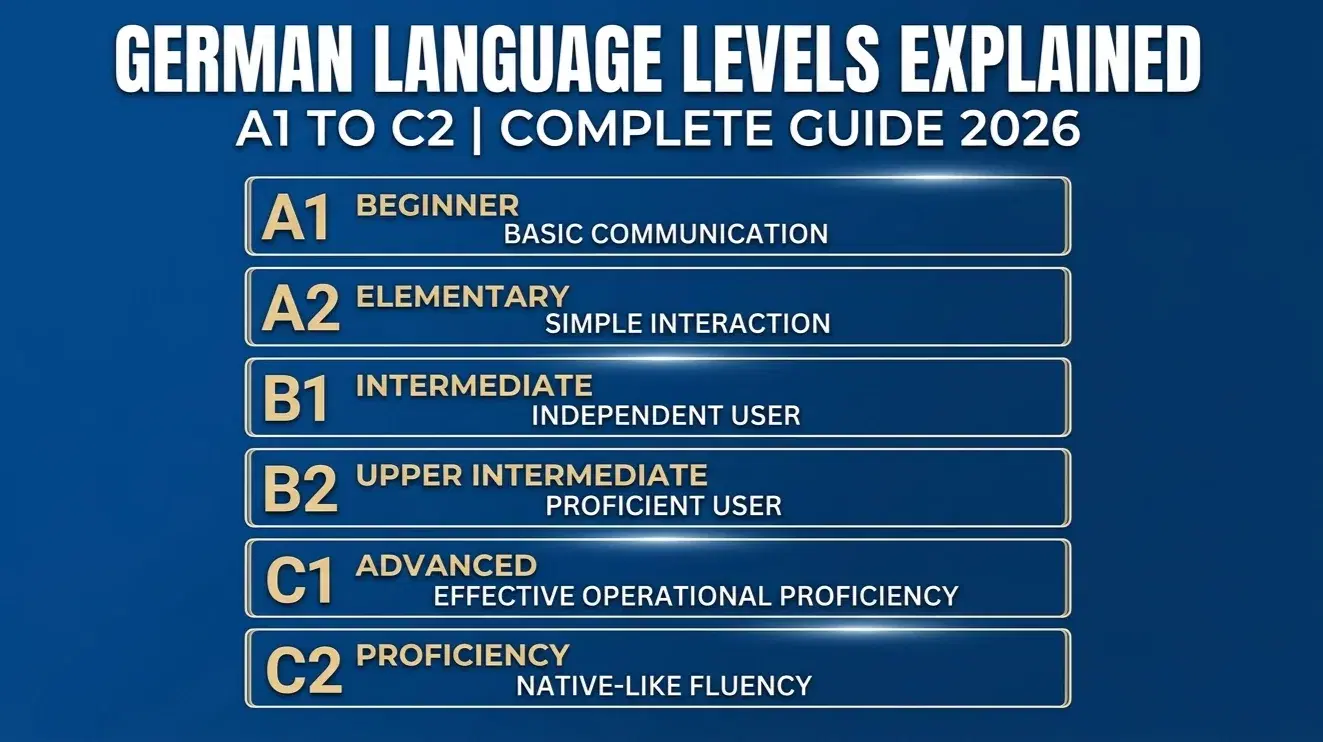
German is organized into six proficiency levels under the Common European Framework of Reference for Languages (CEFR): A1, A2, B1, B2, C1, and C2. A1 is absolute beginner; C2 is near-native mastery. For most practical purposes working in Germany, completing an Ausbildung, or studying at a German university, you need between B1 and C1. This guide explains what each level means, how long it takes to reach it, which certifications prove it, and which level you need for your specific goal.
Glück Global trains students from A1 to B2 using an AI-integrated learning system, helping Sri Lankans reach exam-ready proficiency faster than traditional classroom-only approaches.
What Is the CEFR and Why Does It Matter for Germany?
The Common European Framework of Reference for Languages (CEFR) is the international standard used by German embassies, employers, universities, and vocational schools to assess language proficiency. Every German language exam Goethe-Institut, ÖSD, telc, TestDaF is mapped to this framework.
When a German employer says "we need B2," or an embassy requires "minimum A1 for family reunification," they are referring to specific CEFR levels with precisely defined competencies. Getting the right level for the right purpose is one of the most critical steps in any Germany migration plan.
A1 - Beginner Level
A1 is the entry point of German. At this level, you can introduce yourself, ask basic questions about prices, locations, and schedules, and understand very simple phrases if someone speaks slowly.
What You Can Do at A1
Introduce yourself and others
Ask and answer questions about personal details (name, address, nationality)
Understand and use familiar everyday expressions
Interact in a very basic way when the other person speaks slowly and clearly
Example Sentences at A1
Ich heiße Priya. Ich komme aus Sri Lanka. (My name is Priya. I come from Sri Lanka.)
Wo ist der Bahnhof? (Where is the train station?)
Wie viel kostet das? (How much does this cost?)
How Long Does A1 Take?
Study Intensity | Estimated Duration |
Intensive (4–5 hrs/day) | 4–6 weeks |
Standard (1–2 hrs/day) | 2–3 months |
Casual (30 mins/day) | 4–6 months |
Total study hours to reach A1 from zero: 60–150 hours
When Is A1 Needed?
Family Reunification Visa: A1 certificate is the minimum language requirement for spouses of third-country nationals applying to join them in Germany
Chancenkarte (Opportunity Card): 1 point for A1, qualifies for entry alongside other points
Au Pair Visa: A1 is the minimum recommended level; A2 strongly preferred
Starting point for all Germany pathways: A1 is always where the journey begins
A2 - Elementary Level
A2 is the level where German starts becoming practical. You can handle routine situations — shopping, public transport, simple workplace communication — and understand commonly used phrases related to everyday topics.
What You Can Do at A2
Communicate in routine tasks requiring simple, direct exchange of information
Describe in simple terms your background, immediate environment, and immediate needs
Understand sentences about personal and family information, shopping, local geography, employment
Example Sentences at A2
Ich arbeite als Krankenpfleger. Ich gehe jeden Tag um 8 Uhr zur Arbeit. (I work as a nurse. I go to work at 8 o'clock every day.)
Können Sie das bitte wiederholen? (Can you please repeat that?)
How Long Does A2 Take?
Study Intensity | Estimated Duration from A1 |
Intensive (4–5 hrs/day) | 4–6 weeks |
Standard (1–2 hrs/day) | 2–3 months |
Casual (30 mins/day) | 4–5 months |
Cumulative hours from zero to A2: 180–280 hours
When Is A2 Needed?
Preferred minimum for Au Pair positions
Required for the DTZ (Deutsch-Test für Zuwanderer) integration exam in Germany
Foundation required before progressing to B1
B1 - Intermediate Level
B1 is a significant milestone. At this level, you can manage most real-life situations in Germany - at work, at the doctor's, at government offices, and in social settings. B1 is the minimum for Ausbildung in many trades, for German citizenship, and for the Chancenkarte points system.
What You Can Do at B1
Understand the main points of clear standard input on familiar work, school, and leisure topics
Deal with most situations likely to arise while traveling in a German-speaking area
Produce simple connected text on familiar topics
Describe experiences, events, dreams, hopes, and ambitions and briefly explain opinions and plans
Example Sentences at B1
Ich suche eine Stelle als Mechaniker in München. Ich habe drei Jahre Berufserfahrung und spreche Deutsch auf B1-Niveau. (I am looking for a position as a mechanic in Munich. I have three years of professional experience and speak German at B1 level.)
How Long Does B1 Take?
Study Intensity | Estimated Duration from A2 |
Intensive (4–5 hrs/day) | 6–10 weeks |
Standard (1–2 hrs/day) | 3–4 months |
Casual (30 mins/day) | 6–8 months |
Cumulative hours from zero to B1: 380–630 hours
When Is B1 Needed?
German citizenship: B1 is the minimum German language requirement
Chancenkarte: 3 points for B1 (vs. 1 point for A1)
Ausbildung (some trades): B1 accepted, but B2 increasingly preferred by employers
Nursing Ausbildung (B1 path): Enter Germany at B1, upgrade to B2 during training
EU Blue Card (fast-track permanent residency): After 21 months with B1, you can apply for permanent residency
B2 - Upper Intermediate Level
B2 is the most important level for Sri Lankans pursuing Germany pathways. At B2, you can communicate fluently and spontaneously with native speakers, handle complex professional situations, and study or work entirely in German. Most Ausbildung programs, work visas, and university pathways require B2.
What You Can Do at B2
Understand the main ideas of complex text on both concrete and abstract topics, including technical discussions in your field of specialization
Interact with a degree of fluency and spontaneity that makes regular interaction with native speakers quite possible without strain
Produce clear, detailed text on a wide range of subjects and explain a viewpoint giving advantages and disadvantages
Example Sentences at B2
Obwohl die Arbeitsbedingungen anspruchsvoll sind, schätze ich die Möglichkeit, meine Fähigkeiten in einem deutschen Unternehmen weiterzuentwickeln. (Although the working conditions are demanding, I appreciate the opportunity to develop my skills in a German company.)
How Long Does B2 Take?
Study Intensity | Estimated Duration from B1 |
Intensive (4–5 hrs/day) | 8–12 weeks |
Standard (1–2 hrs/day) | 3–5 months |
Casual (30 mins/day) | 7–10 months |
Cumulative hours from zero to B2: 730–1,130 hours
When Is B2 Needed?
Ausbildung visa (most trades and all nursing/healthcare programs): B2 is the standard requirement
§18a Skilled Worker Visa (vocational): Most German employers require B2 for any client-facing or healthcare role
§18b Skilled Worker Visa (academic): B2 commonly requested by employers
Chancenkarte: 4 points for B2 (maximum language points available)
University admission (Fachhochschule / UAS): B2 minimum for German-taught programs
Nursing Ausbildung: B2 is non-negotiable in most hospitals and care facilities
C1 - Advanced Level
C1 is professional-level German. At C1, you can express yourself fluently and precisely in complex academic and professional contexts, understand virtually all spoken and written German, and handle demanding situations with minimal effort.
What You Can Do at C1
Understand a wide range of demanding, longer texts and recognize implicit meaning
Express yourself fluently and spontaneously without much effort
Use language flexibly and effectively for social, academic, and professional purposes
Produce clear, well-structured, detailed text on complex subjects
How Long Does C1 Take?
Cumulative hours from zero to C1: 1,130–1,730 hours
At standard intensity (1–2 hours/day), reaching C1 from scratch takes approximately 18–30 months.
When Is C1 Needed?
University study (research universities and technical universities): C1 is typically required for admission to German-taught programs; TestDaF TDN 4 or DSH-2 is the exam equivalent
Family reunification for children aged 16–17 (if moving without both parents)
German citizenship (naturalization pathway): C1 recommended for full integration; B1 is the legal minimum but C1 strengthens the application
High-level professional roles: Some German employers (law firms, financial institutions, hospitals) require C1 for specialist positions
C2 - Mastery Level
C2 is near-native fluency. At C2, you can understand virtually everything heard or read, and express yourself spontaneously, very fluently, and precisely - including nuances, shades of meaning, and stylistic variations.
C2 is rarely a formal visa or employment requirement. It is relevant for academic linguists, translators, German language teachers, and those pursuing German naturalization who wish to demonstrate the highest competency.
How Long Does C2 Take?
Cumulative hours from zero to C2: 1,630–2,430 hours
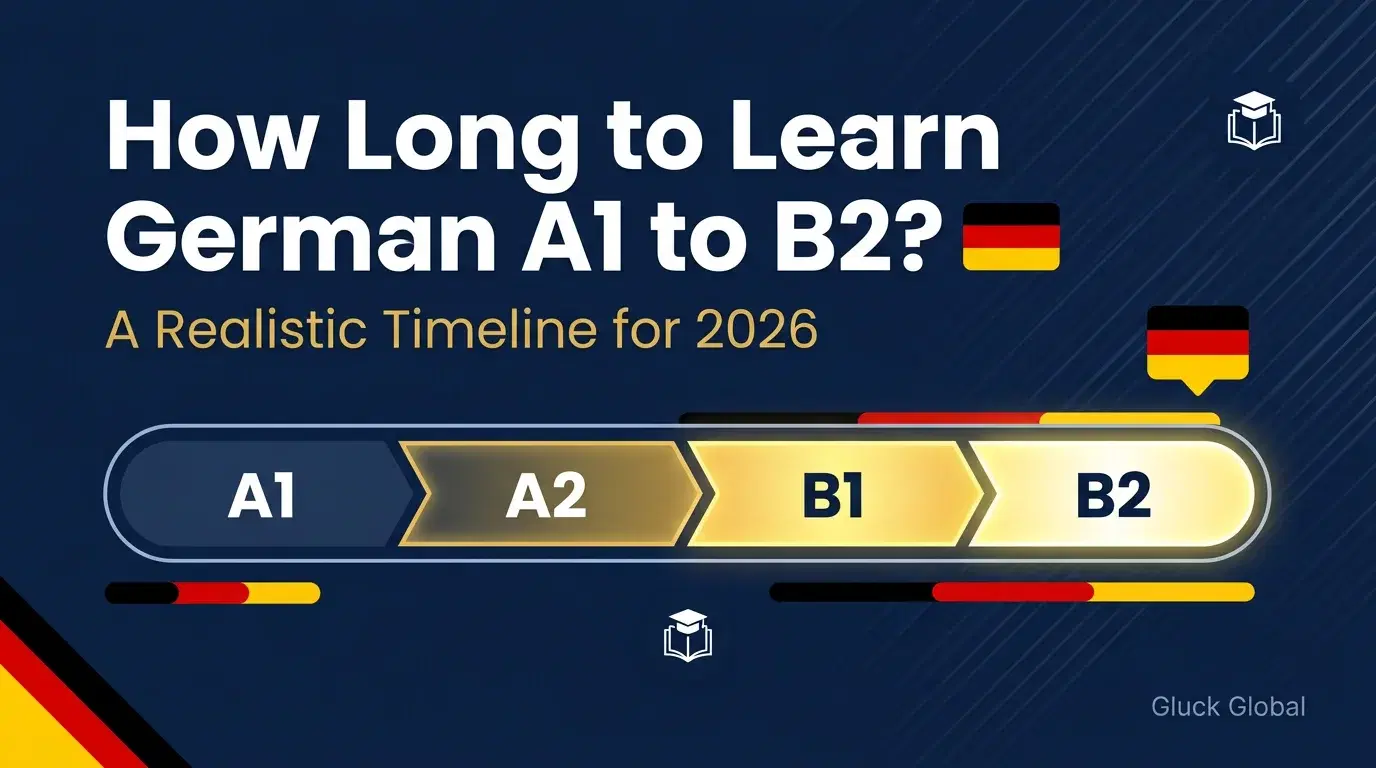
German Language Level Summary: Hours and Timelines at a Glance
Level | CEFR Description | Total Hours from Zero | Standard Pace (1–2 hrs/day) |
A1 | Beginner | 60–150 hours | 2–3 months |
A2 | Elementary | 180–280 hours | 4–5 months cumulative |
B1 | Intermediate | 380–630 hours | 7–10 months cumulative |
B2 | Upper Intermediate | 730–1,130 hours | 14–20 months cumulative |
C1 | Advanced | 1,130–1,730 hours | 24–36 months cumulative |
C2 | Mastery | 1,630–2,430 hours | 3–5 years cumulative |
Note: Glück Global's AI-integrated learning system accelerates this timeline significantly for students with consistent daily engagement.
Which German Level Do You Need? Purpose-Based Comparison Table
Purpose / Pathway | Minimum Level | Recommended Level | Notes |
Family Reunification Visa (spouse) | A1 | A2 | EU Blue Card holders' spouses are exempt |
Au Pair Visa | A1 | A2 | Most host families prefer A2 |
Chancenkarte (Opportunity Card) | A1 | B2 | B2 earns 4 points (max); A1 earns 1 point |
Ausbildung (general trades) | B1 | B2 | B2 expected by most employers |
Ausbildung (nursing/healthcare) | B2 | B2 | B2 is non-negotiable for patient care |
§18a Skilled Worker Visa (vocational) | B1 | B2 | B2 for most roles |
§18b Skilled Worker Visa (academic) | B1 | B2 | B2 common employer expectation |
EU Blue Card | No strict requirement | B1 | B1 needed for 21-month fast-track PR |
University (Fachhochschule) | B2 | B2–C1 | Some English-taught programs accept IELTS |
University (Research/Technical) | C1 | C1 | TestDaF TDN 4 / DSH-2 accepted |
German citizenship | B1 | B1+ | Integration course + DTZ/B1 exam |
Permanent Residency (Blue Card) | B1 | B1 | After 21 months; B1 cert required |
German Language Certification Options: Goethe, ÖSD, TestDaF, and telc
Four major certification bodies offer internationally recognized German language exams. Each has different strengths, availability, and ideal use cases.
Goethe-Institut
The Goethe-Institut is the gold standard for German language certification globally. Its certificates are recognized for virtually all German visa, work, study, and citizenship purposes.
Levels available: A1 to C2Format: Hybrid (paper and digital options in 2026)Exam components: Reading, Listening, Writing, Speaking (each 25 points, minimum 60/100 to pass each module)Key feature: As of 2026, individual failed modules can be retaken separately, a cost-saving advantage Result time: 2–4 weeks Booking: Sells out 2–3 months in advance; book early Best for: Visas, work permits, citizenship, general recognition
Typical cost: €150–€250 depending on level and location
ÖSD (Österreichisches Sprachdiplom Deutsch)
ÖSD is the Austrian equivalent of the Goethe-Institut exam, fully recognized in Germany for visa and work permit purposes.
Levels available: A1 to C2Format: Paper-based Key feature: Monthly exam dates with more available seats than Goethe; often slightly cheaper Result time: 3–5 weeks Best for: Backup when Goethe is sold out; Austria-bound applicants; visa applications
In Sri Lanka, ÖSD exams are offered through GRMAN LK (grman.lk and studyingermany.lk).
TestDaF (Test Deutsch als Fremdsprache)
TestDaF is designed specifically for university admission in Germany. It tests academic German at the B2–C1 level and is required or preferred by most German research universities and technical universities.
Levels available: B2–C1 (scored as TDN 3, 4, or 5 per module)Format: Mostly digital in 2026; computer-based speaking (microphone, no examiner present)Key feature: TDN 4 in all four modules is the standard requirement for most universities Fixed exam dates: Only 6–9 dates per year worldwide limited flexibility Retake policy: Must retake the entire exam (cannot retake individual modules)Result time: ~4 weeks Best for: University applicants (required by research universities and TUs)
telc Deutsch
telc offers practical, flexible German exams with monthly scheduling and specialized versions for healthcare workers.
Levels available: A1 to C1 (including C1 Hochschule for university)Specialized version: telc Deutsch B2 Pflege, specifically designed for nurses and healthcare professional's Key feature: Combined scoring high marks in one section can offset lower marks in another Format: Mostly paper-based; face-to-face speaking with examiner Retake policy: Oral and written parts can be retaken separately Result time: 4–6 weeks Best for: Healthcare workers (B2 Pflege version), flexible scheduling, university applicants when TestDaF dates don't work
German Language Exam Quick-Decision Guide
Your Goal | Best Exam | Alternative |
Work visa / residence permit | Goethe-Institut B1/B2 | telc B1/B2 or ÖSD |
University admission | TestDaF (TDN 4) | telc C1 Hochschule |
Nursing / healthcare Ausbildung | telc B2 Pflege | Goethe B2 |
Family reunification (A1) | Goethe A1 | ÖSD A1 or telc A1 |
Chancenkarte points | Goethe A1–B2 | ÖSD or telc (same levels) |
Citizenship | Goethe B1 | telc B1 (DTZ) |
Introverts (no face-to-face speaking) | TestDaF | — |
Tips for Each Level: How to Progress Faster
A1 Tips
Learn the 100 most common German words first. they cover 50% of everyday speech
Focus on pronunciation early; German spelling is largely phonetic and consistent
Use the Goethe-Institut's free online A1 exercises and vocabulary lists
Practice 20–30 minutes daily rather than long, infrequent sessions
A2 Tips
Master German sentence structure (verb-second rule) - this underpins all further learning
Learn separable verbs (abfahren, aufstehen) as complete units, not word-by-word
Practice describing your daily routine using present tense; expand to past tense (Perfekt)
Watch simple German videos with German subtitles (not English)
B1 Tips
Focus heavily on Konjunktiv II (conditional) and Präteritum (narrative past) - common exam topics
Read short German news articles (e.g., Deutsche Welle Langsam gesprochene Nachrichten / slow German news)
Practice two-person role plays for exam speaking sections (typical B1 exam format)
Do at least one full practice exam before the official test
B2 Tips
Read authentic German texts — newspaper articles, instruction manuals, workplace emails
Practice expressing opinions and arguments formally — B2 writing tasks require structured reasoning
Build domain-specific vocabulary for your target profession (medical, technical, or trade terminology)
Glück Global's AI-integrated system provides adaptive vocabulary drills and personalized weak-spot targeting at this level
C1 Tips
Read academic and literary texts; engage with German podcasts and documentaries without subtitles
Practice paraphrasing and summarizing complex arguments
Work on academic writing conventions (Erörterung, argumentation structure)
How Glück Global's AI-Integrated System Accelerates Learning
Traditional German language courses follow a fixed schedule, same content, same pace, same exercises for every student. Glück Global's approach is different.
The AI-integrated learning system personalizes every student's journey by:
Diagnosing weak spots: The system identifies specific grammar patterns, vocabulary gaps, and pronunciation issues unique to each student - rather than making everyone work through the same material
Adaptive spaced repetition: Vocabulary and grammar rules are reviewed at scientifically optimal intervals, maximizing retention without wasted review time
Exam-aligned practice: Every practice session is calibrated to the actual format of the Goethe exam the student is targeting
Progress tracking: Students and the Glück Global team can see exactly where the student sits against the exam pass threshold at any moment
Multilingual instruction: Classes are taught in English, Tamil, Sinhala, or Malayalam removing the barrier of having to understand German explanations in German
The result: Glück Global's students consistently reach B1 in 4–5 months and B2 in 8–10 months from zero compared to the 10–20 month standard timeline at casual study intensity.
With 350+ enrolled students and a 95% successful placement rate, the system has been validated across hundreds of real migration outcomes.
How Long Does It Take to Go from Zero to B2 with Glück Global?
The typical Glück Global student pathway:
Phase | Duration | Level Achieved |
Foundation (A1–A2) | 2–3 months | A2 |
Intermediate (B1) | 2–3 months | B1 |
Upper Intermediate (B2) | 2–3 months | B2 |
Total A0 to B2 | 6–9 months | B2 (exam-ready) |
This timeline assumes consistent daily engagement with both in-class instruction and the AI system's supplementary exercises. Students who commit to daily practice consistently outperform those with irregular study patterns.


Comments