Career Options in Germany for Sri Lankan Professionals: Your 2026 Roadmap
Explore high-growth Career Options in Germany for Sri Lankan Professionals. Learn about top sectors like IT & Nursing, visa steps, and how Gluck Global helps you settle.

For ambitious professionals in Sri Lanka, the question is no longer whether to consider Germany - it is how to get there as efficiently as possible. With over 400,000 vacant positions across key sectors and a Skilled Immigration Act that explicitly welcomes qualified non-EU citizens, Germany has transformed its approach to international talent. This guide is your 2026 roadmap - covering the highest-demand sectors, the exact preparation steps, and the common mistakes that delay or derail the journey.
Top Sectors: Where Career Options in Germany Are Most Open for Sri#
Lankans
Germany's labour shortage is not general - it is concentrated in specific, high-value industries. Sri Lankan professionals with backgrounds in the following areas will find the shortest and most supported pathway to employment and long-term residency.
1. Healthcare - Nurses, Doctors, and Allied Health
The single most urgent labour need in Germany is in healthcare. An ageing population and a decade of underinvestment in domestic training have created a structural deficit that cannot be resolved without international recruitment. German hospitals and geriatric care centres are actively seeking Sri Lankan candidates.
- Registered Nurses - the most in-demand role; hospitals offer relocation packages and structured recognition (Anerkennung) support for international candidates
- General Practitioners and Specialists - rural areas face the most severe shortages; C1 Medical German ( Fachsprachenprüfung) is required in addition to B2 general German
- Language requirement - B2 German for nursing; C1 for doctors. This is a legal, non-negotiable requirement for Anerkennung - not an employer preference
2. IT and Digitalisation
Germany's digital transformation agenda has made IT one of the most accessible career options for Sri Lankan professionals - particularly for EU Blue Card applicants. Berlin, Munich, and Hamburg compete actively for global tech talent, and many companies operate entirely in English.
- Key roles - Software Engineers (Java, Python, C++), Cloud Architects, Data Scientists, Cybersecurity Analysts
- EU Blue Card advantage - IT specialists can qualify with three years of verifiable professional experience within the last seven years, even without a university degree, under the 2024/2025 Skilled Immigration Act reforms
- Language note - English is sufficient for many roles at the visa stage; B1–B2 German is strongly recommended for SME (Mittelstand) roles and faster career progression
3. Engineering and STEM Disciplines
Germany's global reputation for engineering excellence creates strong, sustained demand across mechanical, electrical, civil, and renewable energy engineering. The Energiewende (energy transition) has further accelerated opportunities in wind, solar, and energy systems engineering.
- Mechanical Engineering - automotive and industrial production
- Electrical and Electronic Engineering - automation and control systems
- Civil Engineering - large-scale infrastructure and housing construction projects
- Renewable Energy - wind turbine engineering, solar installation, and energy consulting
4. Skilled Trades, Logistics, and Ausbildung
Beyond academic professions, Germany has a chronic shortage of certified tradespeople - and as the logistics hub of Europe, the supply chain sector is consistently hiring skilled operatives and coordinators.
- Skilled Handwerk roles - electricians, plumbers, welders, and HVAC technicians qualify for the Skilled Worker Visa if their Sri Lankan certification is assessed as equivalent to a German Berufsabschluss
- Ausbildung pathway - for younger or less-experienced candidates, a paid vocational training programme in Germany provides both an income and a direct qualification, leading straight into the German labour market
- Logistics and supply chain - warehouse coordinators, freight specialists, and operations managers are in consistent demand; A2–B1 German is typically sufficient for entry-level roles
The Three Pillars of Preparation#
Identifying the right sector is the first step. What separates successful applicants from those who stall is systematic preparation across these three areas - ideally started 12–18 months before your planned move date.
1. German Language Proficiency
German is not a suggestion - it is a fundamental requirement for social integration and, in most professions, a legal pre-condition for employment.
| Level | What It Unlocks | Who Needs It |
|---|---|---|
| A2 / B1 | Anmeldung, banking, local authority dealings, Ausbildung entry, logistics roles | All migrants - minimum for independent daily life |
| B2 | Nursing Anerkennung, skilled trade visa, most SME roles; EU Blue Card permanent residency fast-track (21 months) | Nurses, tradespeople, engineers, IT professionals in SMEs |
| C1 | Medical practice (Fachsprachenprüfung), senior management, law and compliance roles | Doctors, senior professionals in regulated fields |
2. Document Recognition and Bureaucracy
German bureaucracy is meticulous - every document must be original, correctly translated, and submitted through the right channel. Three steps are critical before any visa application:
- Anabin / ZAB check - verify your Sri Lankan university and qualification against the Central Office for Foreign Education (ZAB) database. If your degree is not listed as equivalent, a formal assessment must be initiated - which takes time
- Certified translations - all academic certificates, police clearance reports, and personal documents must be translated by a sworn translator recognised by the German Embassy in Colombo. Incorrect or uncertified documents are the most common reason for visa rejection
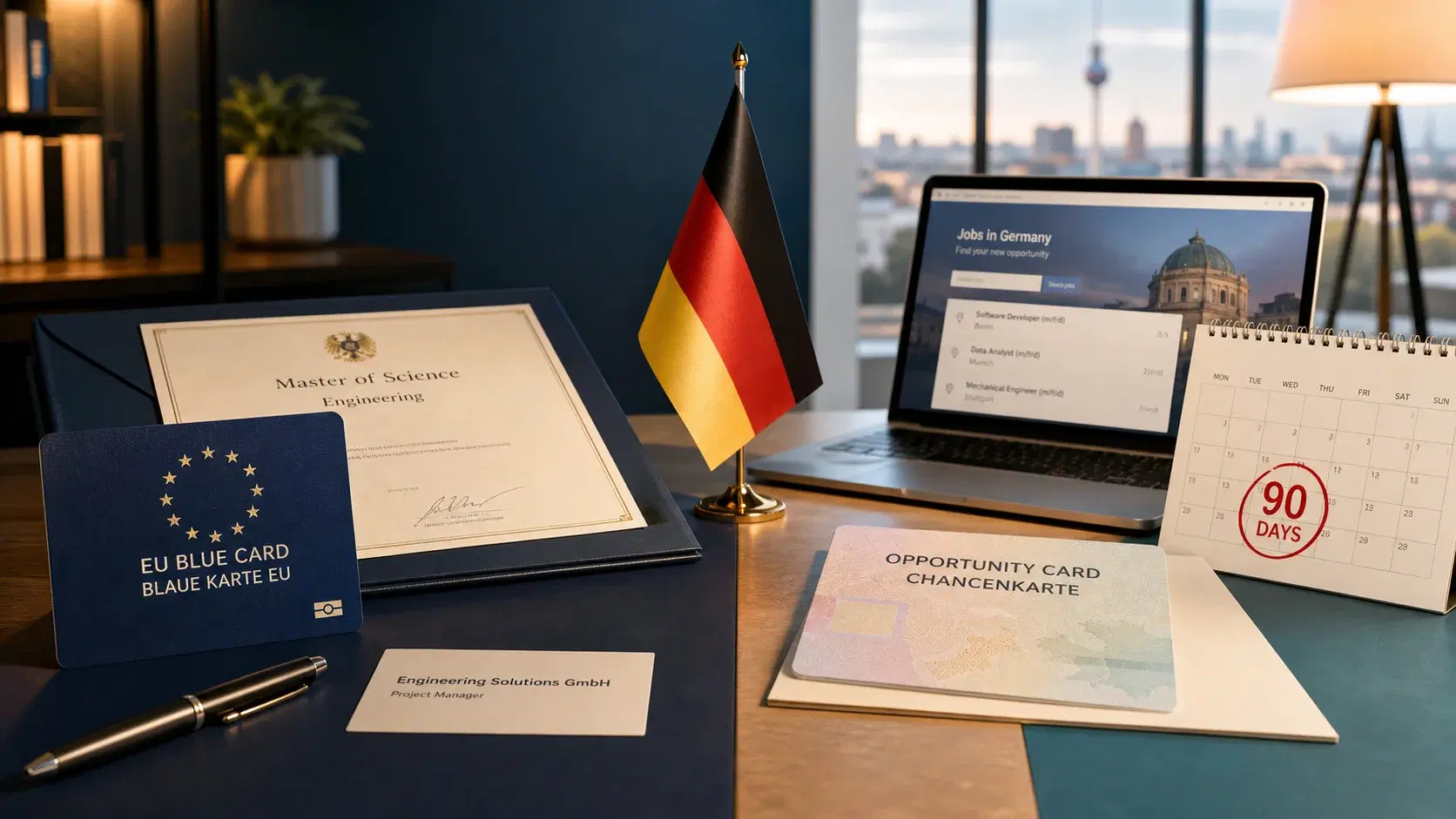
- Right visa pathway - EU Blue Card (for degree holders above the salary threshold), Opportunity Card (for job-seekers with recognised qualifications and a points score of 6+), or Skilled Worker Visa (§ 18a for vocational qualifications). Applying through the wrong category delays your case by months
3. Cultural and Financial Readiness
A successful move to Germany is not just a logistical challenge - it requires a mindset shift.
- Punctuality - in Germany, on time means 5–10 minutes early. This applies to job interviews, appointments, and professional settings without exception
- Direct communication - German workplace feedback is clear and factual, not softened. Receiving direct criticism is professional, not personal - and it is the fastest way to improve
- Financial stability - for the Opportunity Card, you must demonstrate approximately €13,092 in a blocked account. For the student visa, €11,904 (2026). Housing in major cities is highly competitive - securing accommodation before departure is strongly advisable
How Glück Global Guides Your Journey End-to-End#
The combination of language requirements, document complexity, and post-arrival administration is precisely why specialist support makes the difference between a smooth move and a stressful, expensive delay.
- German language training (A1 to B2) - live online classes in Sinhala, Tamil, and English, structured for Goethe-Institut exam preparation and aligned to your professional visa requirements
- Visa and documentation - end-to-end management of certified translations, Anabin/ZAB verification, and embassy application submission including mock interviews
- Job placement and CV preparation - German-format CV writing, direct employer connections across healthcare, IT, engineering, and skilled trades, and representation to companies committed to sponsoring international professionals
- Post-arrival support - Anmeldung guidance, blocked account and health insurance setup, bank account opening, and integration support for your first weeks in Germany
The current moment is exceptional - Germany needs Sri Lankan talent and has built a legal framework to welcome it. The path is clear for those who prepare correctly. Contact Glück Global for a free eligibility assessment →
Frequently Asked Questions#
What are the most in-demand career options in Germany for Sri Lankan
professionals?
Healthcare (nurses and doctors), IT (software engineers, cloud architects, cybersecurity), engineering (mechanical, electrical, civil, and renewable energy), and skilled trades (electricians, plumbers, HVAC technicians) are the most in-demand sectors. Germany's labour deficit is concentrated in these fields, making them the fastest and most supported pathways to employment and long-term residency.
Do I need German language skills to work in Germany as a Sri Lankan
professional?
Yes - for most professions. Nursing and trade roles require at least B2 German as a legal condition for qualification recognition. IT and engineering roles can often be entered with English for the visa, but B1–B2 German is strongly recommended for career growth and EU Blue Card permanent residency fast-tracking. A2 is the minimum for independent daily life.
Which German visa is right for a Sri Lankan professional?
It depends on your qualifications and whether you have a job offer. EU Blue Card - degree holders with a signed offer above the salary threshold. Opportunity Card - qualified job seekers without an offer (6 points required). Skilled Worker Visa (§ 18a) - vocational qualification holders in recognised shortage occupations. Glück Global provides a free eligibility assessment to identify the correct pathway for your specific profile.