How Long Does It Take to Learn German from A1 to B2?
Wondering how long to learn German A1 to B2? Discover a realistic level-by-level timeline, study hours, and expert tips to reach B2 faster in 2026.
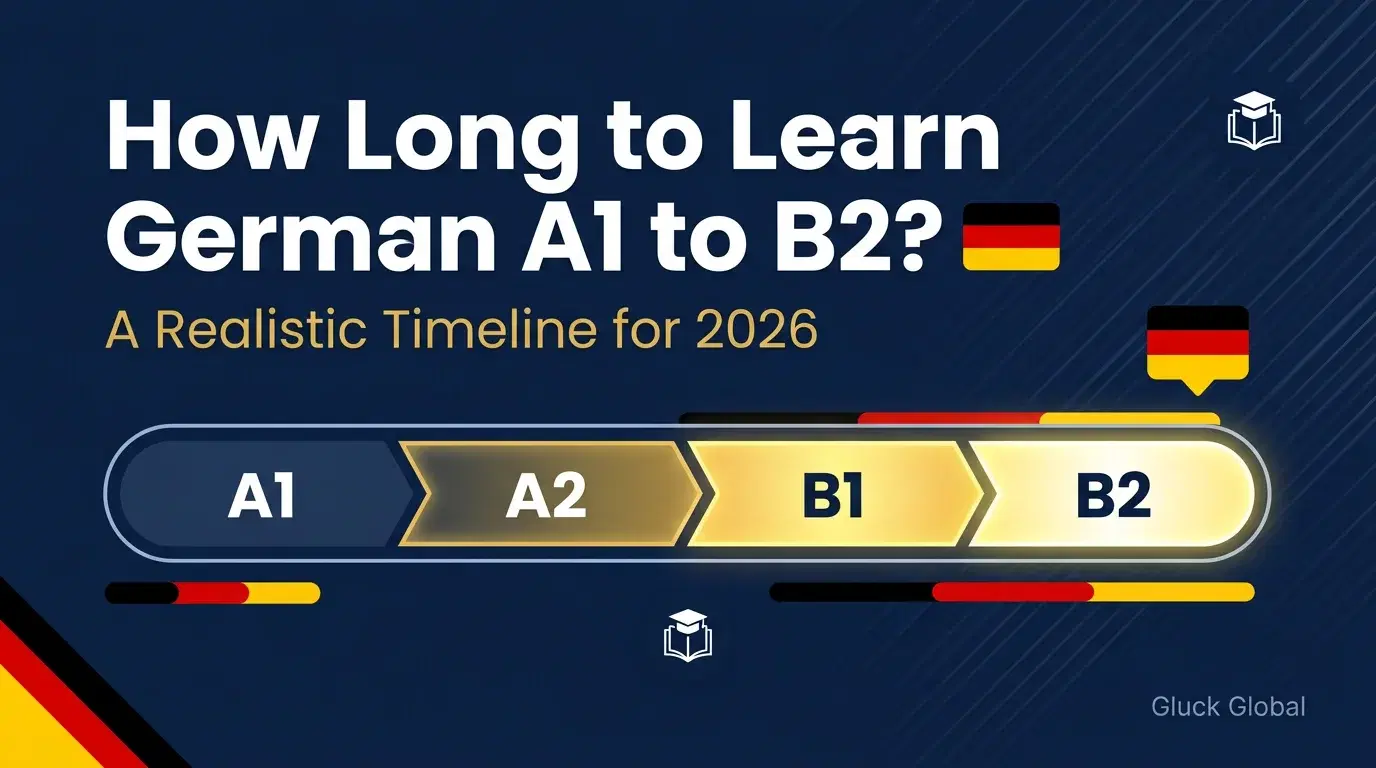
“How long to learn German A1 to B2?” - it's the first question every serious German learner asks, and it deserves an honest answer. Not the overly optimistic “you can do it in 3 months!” kind, and not the discouraging “it takes years” kind either. The truth sits in the middle, and it depends on exactly three things: how much time you study each week, how structured your training is, and how consistent you stay.
Here is the complete, realistic breakdown - level by level, with real hours and real timelines.
Understanding the CEFR Framework First#
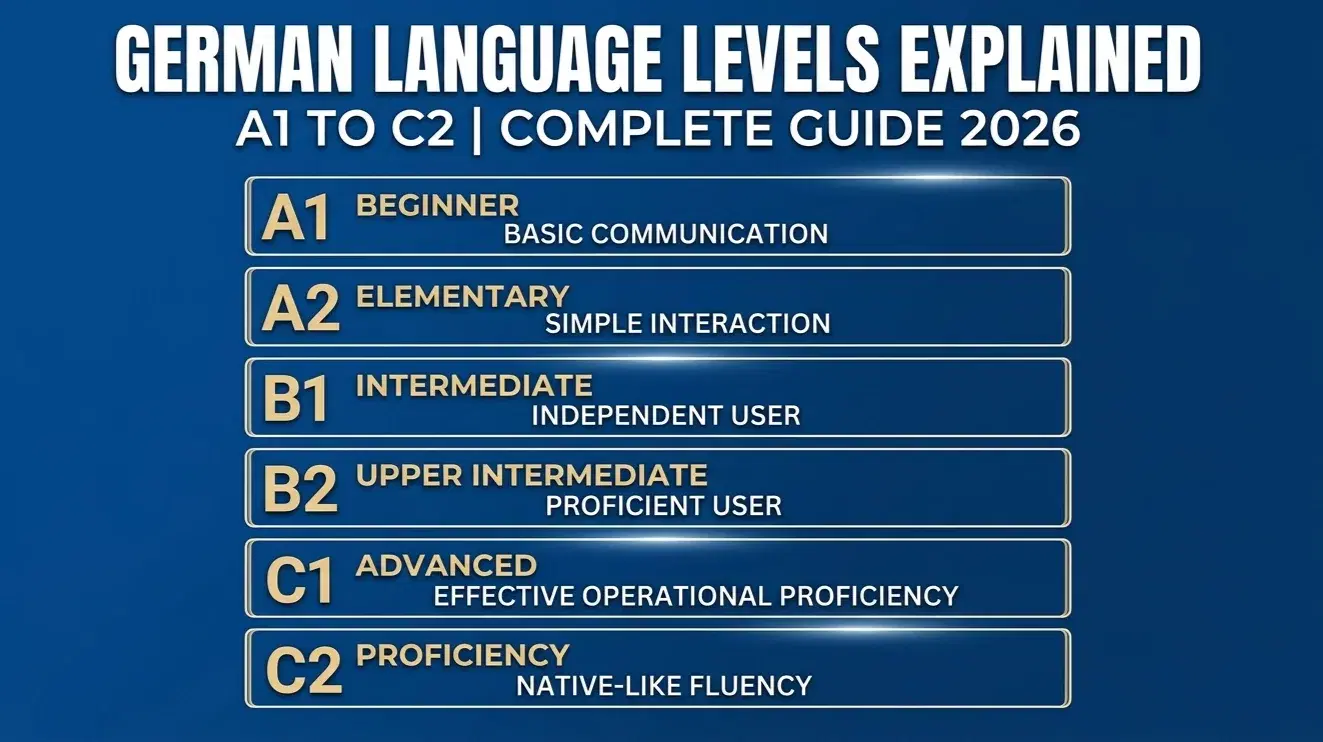
German language proficiency is measured using the Common European Framework of Reference for Languages (CEFR) - the globally recognised standard used by the Goethe-Institut, ÖSD, universities, and German visa authorities. The framework runs from A1 (complete beginner) to C2 (native-like mastery), with B2being the most commonly targeted level for students aiming to study, work, or migrate to Germany. Each level represents a distinct set of communication skills. A1 gets you through basic introductions and daily phrases. B2 puts you in a position to hold complex conversations, write professional emails, follow university lectures, and pass most German visa language tests - comfortably. ## How Long to Learn German A1 to B2: Level-by-Level Breakdown ### A1 - The Starting Point (60–150 Hours | 2–3 Months) A1 is where everyone begins. At this level, you learn to introduce yourself, count, understand basic instructions, and handle simple daily interactions. The vocabulary target is around 500 words, and the grammar covers present tense verbs, basic sentence structure, and common pronouns. With regular study of 5–10 hours per week, most learners reach A1 in2 to 3 months. Intensive learners studying 20+ hours per week can clear A1 in as little as 4 to 6 weeks. The Goethe A1 exam is highly achievable at this stage with the right preparation.
A2 - Building Everyday Fluency (150–260 Hours | 2–3 Months More)
A2 expands your ability to handle routine situations - describing your work, your daily schedule, your family, and your immediate environment. Vocabulary grows to approximately 1,500 words, and grammar introduces past tenses, modal verbs, and comparative structures.
Adding another 2 to 3 months of consistent study brings you to A2. By this stage, you can hold simple but complete conversations on familiar topics and begin to understand written German in everyday contexts.
B1 - Conversational Independence (260–490 Hours | 3–4 Months More)
B1 is a major milestone. It is the level required for most Ausbildung applications, the German integration test, and the basic language requirement for several visa pathways. At B1, you can deal with most real-life situations in Germany - shopping, appointments, banking, and workplace conversations - without struggling.
Vocabulary at B1 reaches around 3,000 words, and grammar at this level includes complex sentence structures, subordinate clauses, and the subjunctive mood. Reaching B1 from A2 takes an additional 3 to 4 months of regular study, bringing cumulative study time to approximately 300–400 hours.
B2 - Professional and Academic Proficiency (450–600 Hours | 3–4
Months More)
B2 is the level that opens the widest range of doors in Germany. It is required for university admission at most German institutions, for certain skilled worker visas, and for professional environments where complex communication is expected. At B2, you can understand the main ideas of complex texts, interact fluently with native speakers, and express opinions clearly on a wide range of topics.
Reaching B2 from B1 requires another 3 to 4 months of focused preparation, bringing total study time from A1 to 450–600 hours. The Foreign Service Institute (FSI) estimates German requires approximately 750 hours for full professional proficiency - B2 places you firmly on that track.
Total Timeline: A1 to B2 at a Glance#
| Level | Study Hours | Time (Intensive) | Time (Regular) |
|---|---|---|---|
| A1 | 60–150 hrs | 4–6 weeks | 2–3 months |
| A2 | 150–260 hrs | 6–8 weeks | 2–3 months |
| B1 | 260–490 hrs | 8–10 weeks | 3–4 months |
| B2 | 450–600 hrs | 10–12 weeks | 3–4 months |
| A1 → B2 Total | ~600 hrs | ~9–10 months | 12–14 months |
What Actually Determines How Fast You Progress?#
Knowing the hours is useful. Understanding what drives or slows your progress is what gives you real control over your timeline.
Consistency Beats Intensity Every Time
A learner who studies 1.5 hours daily, five days a week, will outperform someone who studies 5 hours on a Sunday and nothing the rest of the week. Language acquisition is a habit, not a sprint.
Structured Guidance Shortens Timelines Dramatically
Self-study through apps alone is the slowest path. Learners in structured classes with qualified instructors, exam preparation, and regular feedback move through levels measurably faster than self-study learners.
Active Practice Is Non-Negotiable
Reading and listening alone will not get you to B2. Speaking practice, writing exercises, mock examination papers, and real conversation time are what convert passive understanding into active fluency.
Your Learning Environment Matters
Students with access to AI-powered practice tools, live doubt-clearing sessions, and mock Goethe/ÖSD exams arrive at their exam date significantly better prepared than those without.
Why B2 Is the Level Worth Working Towards#
Many learners stop at B1, thinking it is enough. For Ausbildung, it often is. But B2 is the level that truly transforms your opportunities in Germany:
- German universities require B2 for admission to most Bachelor's and Master's programmes
- Professional roles requiring complex written and spoken communication demand B2
- The EU Blue Card pathway becomes significantly smoother with B2 certification
- Nursing registration in Germany (Pflegefachkraft) requires B2 under the Pflegeberufegesetz
- With B2 secured, reaching C1 - the level of near-native professional fluency - takes only a few more months of continued study
If Germany is your destination, B2 is not a stretch goal. It is the baseline worth committing to from day one.
Start Your A1 to B2 Journey with Glück Global#
At Glück Global - Sri Lanka's No. 1 Digitalized German Learning Platform - every course level is designed to get you from A1 to B2 in the most efficient, structured, and examination-ready way possible:
- AI-powered chatbot - 250+ minutes of intelligent language practice every month, available 24/7
- Dedicated student portal - tracks your progress level by level so you always know exactly where you stand
- Mother-tongue instruction - Goethe and ÖSD certified instructors teach in English, Tamil, Sinhala, or Malayalam, so you understand faster and retain more
- 91% exam excellence rate - with 47+ certified students, our results speak for themselves
Whether you are aiming for Ausbildung, a German university, or a work visa - your B2 journey starts here.
Frequently Asked Questions#
Can I learn German A1 to B2 in one year?
Yes - with consistent, structured study. At a regular pace of 1–2 hours per day, most learners complete A1 to B2 in 12–14 months. Intensive learners studying 20+ hours per week can complete the journey in 9–10 months.
How many hours per day should I study German?
1–2 hours per day (5 days per week) is the most sustainable pace for working adults and students. This adds up to 35–50 hours per month - enough to advance one full CEFR level every 2–4 months. Daily consistency matters more than occasional long sessions.
Is B2 German hard to achieve?
B2 is challenging but achievable with the right structure. The jump from B1 to B2 is the hardest transition - grammar complexity increases and passive vocabulary becomes active. Learners who invest in mock exams, speaking practice, and writing feedback make the B1 to B2 jump most successfully.
Which German exam should I take - Goethe, TELC, or ÖSD?
For Germany visa purposes, all three are officially recognised. Goethe-Zertifikat is the most internationally prestigious and widely accepted. TELC is accepted across all German visa pathways including the EU Blue Card. ÖSD is an Austrian-based exam with full German recognition. Glück Global prepares students for Goethe and ÖSD certifications.
Do I need German to apply for the EU Blue Card or Opportunity Card?
Not always - but having German accelerates both. The Opportunity Card awards additional points for German language proficiency. The EU Blue Card has no mandatory German requirement at the visa stage but B2 significantly expands the range of qualifying job offers available to you.