Study in Germany: Your Complete Guide to Higher Education Opportunities
Discover everything about Study in Germany, from admission to lifestyle and career prospects. Study in Germany for world-class education and opportunities!
Germany has become one of the most sought-after study destinations in the world - and for good reason. World-class universities, no tuition fees at public institutions, a thriving job market after graduation, and a central location in Europe make Germany an outstanding choice for Sri Lankan and South Asian students. This guide covers everything you need to know to plan your journey to study in Germany - from entry requirements and costs to scholarships, student life, and what comes after your degree.
Why Choose Germany for Higher Education?#
Over 400,000 international students study in Germany every year - the third-highest number globally. Here is what makes Germany stand out from other popular destinations:
- No tuition fees at most public universities - only a semester contribution of approximately €300–€350 per semester covering administrative costs and often a semester transport ticket
- World-ranked universities - TU Munich, LMU Munich, RWTH Aachen, Heidelberg University, and Humboldt University are globally recognised
- 18-month post-study work visa - among the most generous in Europe, giving you time to find a job directly related to your qualification
- Internationally recognised degrees - a German qualification carries weight in Europe, Asia, the Middle East, and beyond
- Diverse, multilingual environment - students from over 180 countries study in Germany, with thousands of English-taught programmes available
Requirements to Study in Germany#
Academic Qualifications
For undergraduate programmes, you need a secondary qualification equivalent to the German Abitur. Sri Lankan A/L results generally qualify, though some universities require you to complete one or two years of a local university programme first, or to pass a Feststellungsprüfung (university entrance assessment) via a Studienkolleg. For postgraduate programmes, a completed bachelor's degree in a relevant field is required.
Language Proficiency
Germany offers programmes in both German and English:
- English-taught programmes: IELTS 6.0–7.0 or TOEFL 80–100 (varies by institution)
- German-taught programmes: TestDaF (level 4) or DSH-2 certificate
Even if your entire programme is in English, learning German to at least A2–B1 level will dramatically improve your daily life, part-time job prospects, and integration into Germany.
At Glück Global, we offer live online German language courses from A1 to B2 taught in Sinhala, Tamil, and English
- designed around the timelines and requirements of Sri Lankan students planning to study in Germany. Explore our German Language Programme →
Financial Proof - Blocked Account
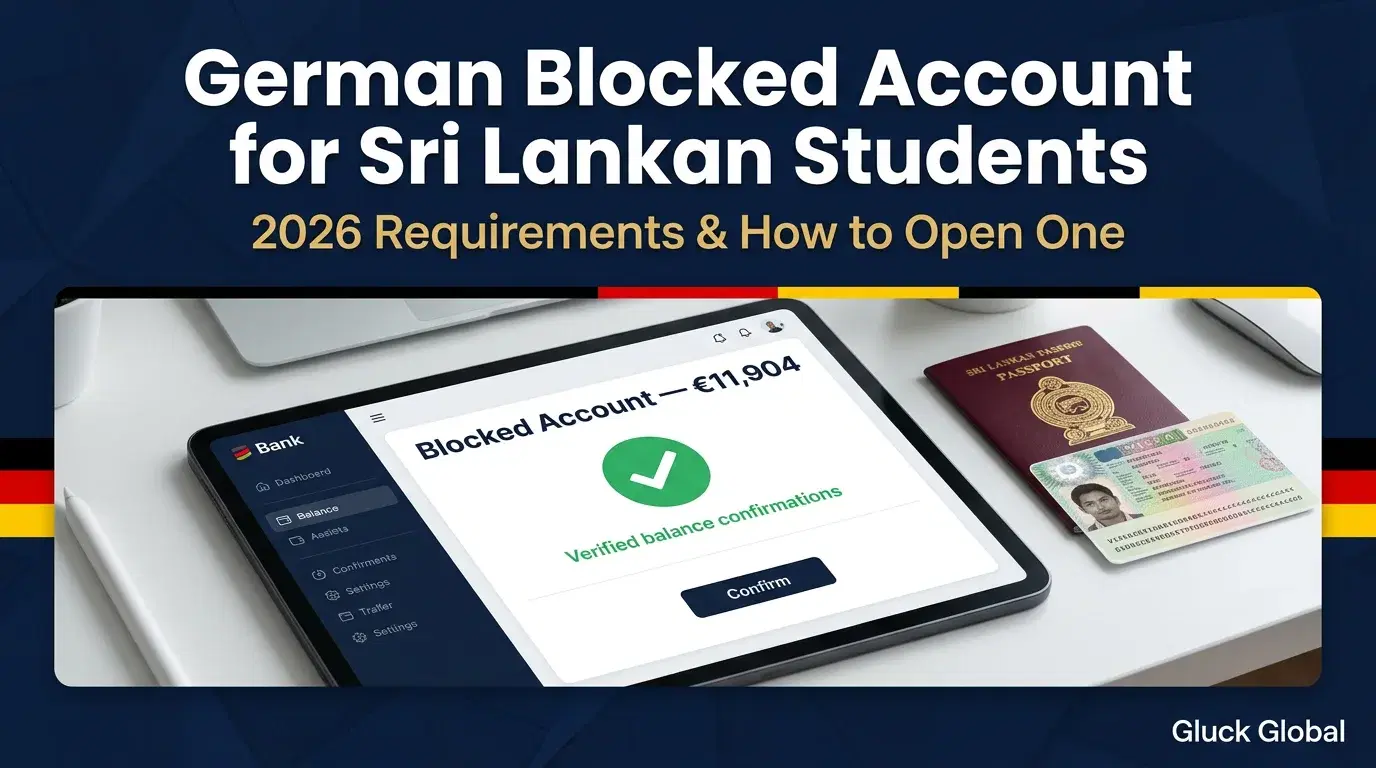
To obtain a student visa, you must demonstrate sufficient financial resources. The current requirement is a blocked account (Sperrkonto) holding at least €11,904 per year (as of 2026 - equivalent to €992/month). Trusted providers for Sri Lankan students include Fintiba and Expatrio. This amount is released to you monthly after arrival and covers living expenses in Germany.
Student Visa (National Visa - Type D)
Non-EU students must apply for a German student visa at the German Embassy in Colombo. Required documents include:
- University admission letter
- Proof of blocked account or financial means
- Health insurance valid in Germany
- Valid passport and biometric photos
- Academic certificates and language test results
- Completed visa application form
Health Insurance
Health insurance is mandatory for all students in Germany. Students under 30 can join public insurance (e.g. TK, AOK, DAK) at a reduced rate of approximately €120/month. Students over 30 or those in non-standard programmes must take out private insurance.
Popular Study Fields in Germany#
Engineering and Technology
Germany is a global engineering powerhouse. Mechanical Engineering, Electrical Engineering, Computer Science, and Automotive Engineering are the most in-demand programmes. TU Munich, RWTH Aachen, and the Karlsruhe Institute of Technology (KIT) consistently rank among Europe's best for engineering.
Medicine and Health Sciences
German medical education is research-intensive and highly practical. Admission is competitive - most programmes require strong A/L science results and German language proficiency. After graduation, students can apply for German medical licensure and work in hospitals and clinics.
Business and Management
Berlin, Frankfurt, and Munich are major business hubs. Germany offers a wide range of English-taught MBA and management programmes, particularly at private universities and business schools. Bachelor's programmes in economics and international business are available at public universities with low fees.
Natural and Applied Sciences
Germany's strength in research makes it ideal for Physics, Chemistry, Biology, Environmental Sciences, and Mathematics. Research institutions like the Max Planck Society and Fraunhofer Society are directly connected to university programmes, giving students access to world-leading research environments.
Arts, Design, and Humanities
Germany has a rich creative tradition. Fine arts, industrial design, architecture, philosophy, history, and linguistics are all well-funded at German universities. Many design and arts programmes are offered at specialised Kunsthochschulen (art academies) with internationally recognised faculty.
Cost of Living in Germany for Students#
While tuition is free, day-to-day living costs require careful budgeting. Here is a realistic monthly breakdown:
| Expense | Monthly Estimate (€) |
|---|---|
| Rent (student dorm or shared flat) | €350 – €600 |
| Food and groceries | €200 – €300 |
| Health insurance | €110 – €130 |
| Transport | €0 – €80 (Semesterticket or Deutschlandticket) |
| Miscellaneous | €100 – €150 |
| Total | €800 – €1,200/month |
On a student visa you can work 120 full days or 240 half days per year - which most students use to cover day-to-day costs through part-time work in cafés, retail, campus jobs, or student assistant (HiWi) positions.
Scholarships and Financial Aid#
Several well-funded scholarships are available for international students who study in Germany:
- DAAD (Deutscher Akademischer Austauschdienst) - Germany's largest scholarship organisation, offering grants for all degree levels and disciplines
- Deutschlandstipendium - €300/month merit-based scholarship co-funded by the German government and private companies; available at most public universities
- Erasmus+ - EU-funded mobility grants for exchange semesters within Europe
- University-specific grants - many universities run their own international scholarships, particularly for postgraduate students
Apply for scholarships as early as possible - most deadlines are 6–12 months before the semester starts, and competition is high.
Student Life in Germany#
Studying in Germany is a full cultural experience, not just an academic one. German university cities - Munich, Berlin, Hamburg, Cologne, Stuttgart - offer a rich mix of history, nightlife, nature, and international community.
- Student unions (AStA) organise social events, legal aid, accommodation support, and cultural activities
- International student clubs connect you with peers from your region and help you navigate university life
- Public transport is excellent - most semester tickets cover the entire city network for free or at heavily subsidised rates
- Germany is centrally located in Europe - weekend travel to France, Austria, the Netherlands, and the Czech Republic is affordable and fast
Post-Study Work and Career Opportunities#
Germany offers one of the most generous post-study arrangements for international graduates:
- 18-month job-seeking visa after graduation - allowing you to work in any sector while searching for a role in your field
- Once you secure a qualifying job, convert directly to a skilled worker residence permit - no need to leave Germany
- 27 months of employment (or 21 months with B1 German) leads to permanent residency and family reunification rights
Germany's industries - automotive, IT, healthcare, renewable energy, finance, and manufacturing - are actively recruiting internationally educated graduates. Even for students who plan to return home, a German degree significantly enhances career prospects globally.
How Glück Global Supports Your Study Journey#
- University selection and application support - we match your qualifications, interests, and budget to the right programme and institution
- German language training - A1 to B2 live online classes in Sinhala, Tamil, and English, aligned to TestDaF and DSH preparation
- Visa documentation guidance - full support from blocked account setup to embassy appointment preparation
- Pre-departure orientation - accommodation search, travel logistics, cultural preparation, and what to do on day one in Germany
- Post-arrival support - Anmeldung, bank account, SIM card, and connecting you with Sri Lankan communities in your city
Ready to make Germany your study destination? Contact Glück Global for a free personalised consultation →
Tips Before You Apply#
- Start the process at least 9–12 months before your intended semester start
- Begin German language training early - even if your programme is in English
- Set up your blocked account as soon as you receive your admission letter
- Apply for scholarships in parallel - they can significantly reduce your financial burden
- Book student accommodation early - university cities are competitive, especially in Munich, Berlin, and Hamburg
Frequently Asked Questions#
Can Sri Lankan students study in Germany for free?
Yes. Most public universities in Germany charge no tuition fees for international students - only a semester contribution of around €300–€350. You will still need to cover living expenses (€800–€1,200 per month) and demonstrate this through a blocked account when applying for your student visa.
What is the minimum German level required to study in Germany?
For German-taught programmes, you need TestDaF level 4 or DSH-2. For English-taught programmes, German is not required - but even A2–B1 German makes your daily life and job search significantly easier. Glück Global recommends starting German language training early regardless of your programme language.
How long can I stay in Germany after graduating?
You can apply for an 18-month post-study job-seeking visa immediately after graduation. During this period you can work in any sector. Once you secure employment in your field, you convert to a skilled worker residence permit - and after 27 months (or 21 with B1 German) you are eligible for permanent residency.