What is the Chancenkarte (Opportunity Card) Point System? A Complete 2026 Breakdown
Discover how the Chancenkarte point system works, who qualifies, and how Sri Lankans can score 6 points to move to Germany without a job offer in 2026.
Germany has opened a door that did not exist before - and it goes by the name Chancenkarte. If you have been researching how to move to Germany without a confirmed job offer, the Chancenkarte point system is the answer you have been looking for. Introduced under Germany's landmark 2023 Skilled Immigration Act and now fully active in 2026, the Opportunity Card gives qualified professionals from non-EU countries - including Sri Lanka - the legal right to enter Germany and job-search on the ground for up to 12 months.
No job offer required. No employer sponsorship needed. Just your qualifications, your language skills, and a minimum of six points.
What Exactly Is the Chancenkarte?#
The Chancenkarte (German for “Opportunity Card”) is a residence permit that allows skilled professionals from outside the EU to live in Germany legally while actively searching for employment. It is not a work permit in itself - it is a job-seeking visa with a generous 12-month window that gives you the time and legal status to meet employers, attend interviews, and secure a position before transitioning to a full work visa.
This is a game-changer for Sri Lankan professionals who previously faced an impossible barrier: you needed a job offer to get a visa, and you needed to be in Germany to get a job offer. The Chancenkarte eliminates that barrier entirely.
Who Can Apply? The Two Qualification Routes#
Route 1 - Direct Eligibility (No Points Required)
If your foreign university degree or vocational qualification is already fully recognised in Germany, or if you obtained your qualification from a German institution, you automatically qualify for the Opportunity Card without needing to accumulate points. You only need to demonstrate that you can financially support yourself during your stay.
Route 2 - The Chancenkarte Point System
If your qualification is not yet fully recognised in Germany, you qualify through the Chancenkarte point system. You need to score a minimum of 6 points from a defined set of criteria covering your qualifications, professional experience, language skills, age, and connection to Germany.
The Chancenkarte Point System - A Complete Breakdown#
Baseline Requirements (No Points Awarded)
Before entering the point system, every applicant must meet two non-negotiable baseline conditions. These are pass/fail requirements
-
meeting them does not award points, they simply make you eligible to enter the points system:
-
Qualification: A university degree or at least 2 years of vocational training recognised in your home country
-
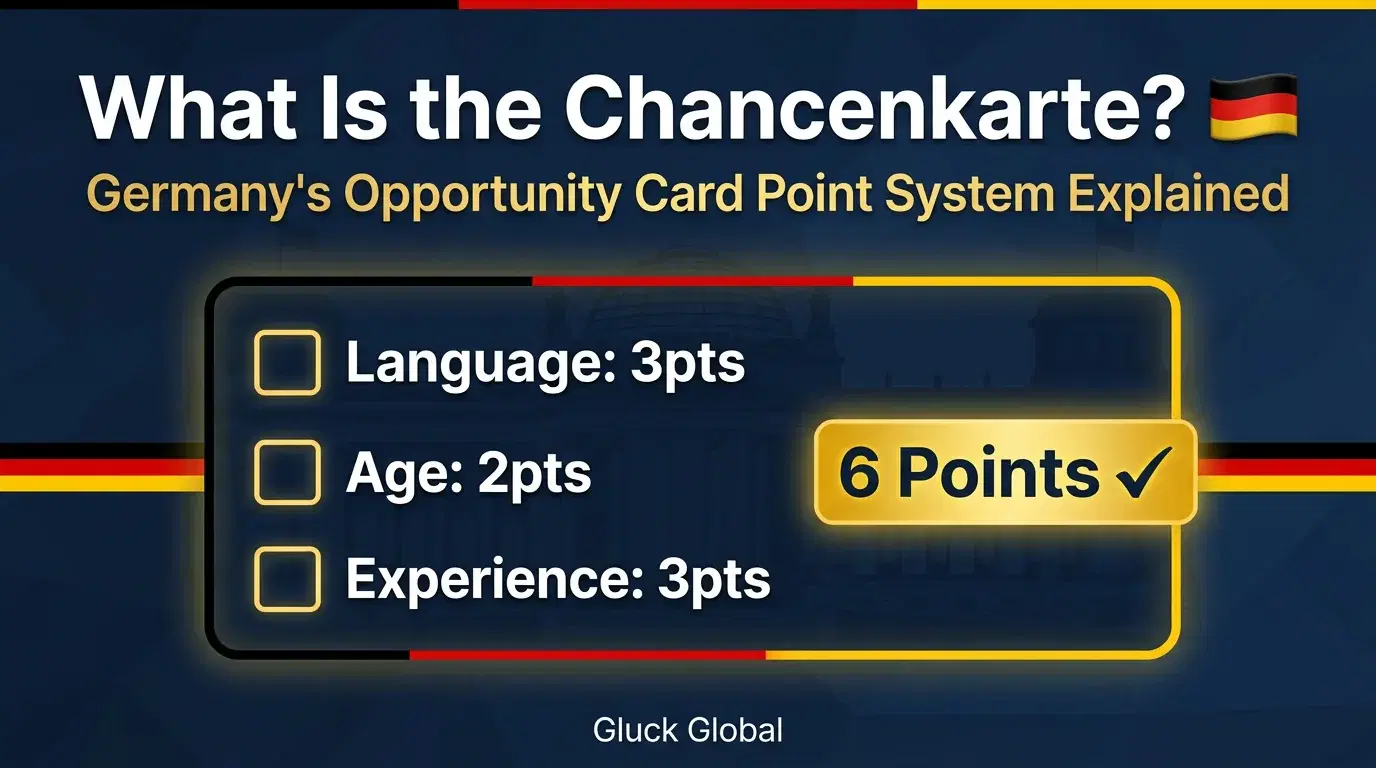
Language: Either German at A1 level or English at B2 level- Financial proof: Sufficient funds to support yourself - typically via a blocked account (minimum €1,027/month) or a part-time employment contract (up to 20 hours/week) ## Points You Can Earn | Criteria | Points Awarded | | --- | --- | | Partial recognition of foreign qualification by German authorities | 4 points | | 5 years of professional experience in the last 7 years | 3 points | | German language proficiency at B2 level or above | 3 points | | 2 years of professional experience in the last 5 years | 2 points | | Age 35 or under at time of application | 2 points | | German language proficiency at B1 level | 2 points | | Age between 36 and 40 at time of application | 1 point | | German language proficiency at A2 level | 1 point | | English language proficiency at C1 level | 1 point | | Qualification in a German shortage occupation | 1 point | | Previous legal stay in Germany for 6+ months (non-tourist) | 1 point | | Spouse also meets the Chancenkarte requirements | 1 point | You need a minimum of 6 points to qualify. Having more than 6 points does not give you any additional advantage - the threshold is the only requirement. ## Real-World Examples: How Sri Lankans Can Reach 6 Points ### Example 1 - IT Professional, Age 28, B2 German - German language B2 or above → 3 points - Age 35 or under → 2 points - English proficiency at C1 → 1 point****Total: 6 points ✓### Example 2 - Engineer, Age 38, No German - 5 years of professional experience in the last 7 years → 3 points - Partial qualification recognition by German authorities → 4 points****Total: 7 points ✓### Example 3 - Nurse or Healthcare Professional, Age 32, B1 German - Qualification in a shortage occupation (healthcare) → 1 point - German language B1 → 2 points - Age 35 or under → 2 points - 2 years of professional experience in the last 5 years → 2 points****Total: 7 points ✓These examples show that many Sri Lankan professionals - engineers, IT specialists, healthcare workers, and others - can meet the threshold with a combination of experience, youth, and language skills. ## Why German Language Is Your Most Powerful Asset in the Point System Look at the points table carefully and one thing stands out immediately: German language proficiency is the single most efficient way to score points in the Chancenkarte point system. - German at A2 earns 1 point - German at B1 earns 2 points - German at B2 earns 3 points - the highest single-category score available for most applicants No other criterion - other than partial qualification recognition - offers 3 points in a single go. For a young professional aged 35 or under, reaching B2 German (3 points) combined with the age criterion (2 points) and English at C1 (1 point) achieves the full 6-point requirement without needing years of experience or a complex qualification recognition process. The bottom line: if you are planning to use the Chancenkarte, learning German is not a nice-to-have. It is your fastest, most controllable path to eligibility. ## What Happens After You Arrive in Germany? Once you receive the Chancenkarte and enter Germany, you have up to12 months to find a job. During this period, you are permitted to take up a part-time job for up to 20 hours per week to supplement your income. If you find a suitable position within the 12 months, you can transition directly to a work visa or EU Blue Card without leaving Germany. If you need more time, a one-time extension may be possible under certain conditions.
Start Your Chancenkarte Journey with Glück Global#
At Glück Global - Sri Lanka's No. 1 Digitalized German Learning and Migration Platform - we help you build the exact profile that qualifies for the Chancenkarte. Our structured A1-to-B2 German courses, AI-powered chatbot practice, dedicated student portal, and certified instructors are designed to take you from zero to Goethe-certified B2 in the most efficient way possible - directly boosting your Chancenkarte point score and your chances of a successful application.
Whether you want to calculate your current points, understand your eligibility, or start building your German language profile today - we are ready to guide you. Check Your Eligibility & Secure Your Place →
Frequently Asked Questions#
How many points do I need for the German Opportunity Card?
You need a minimum of 6 points from the points-based criteria (Route 2). If your qualification is already fully recognised in Germany, you skip the points system entirely and qualify via Route 1.
Does having a degree automatically give me points?
No. Having a degree meets the baseline requirement (which earns no points). Points are only awarded for partial recognition of your qualification (4 points) - which is a separate assessment done by a German recognition authority.
Can I bring my family on the Opportunity Card?
The Opportunity Card itself is individual. However, family reunification is possible after you secure employment and transition to a standard work visa or residence permit. Your partner's eligibility for their own Opportunity Card does earn you 1 bonus point.
What is the financial proof required for the 2026 Opportunity Card?
For 2026, you need to show approximately €12,324 in a blocked account (€1,027/month × 12 months), or an employment contract for a part-time job in Germany of up to 20 hours per week. The blocked account is the most straightforward option for most applicants.