Study in Germany from Sri Lanka: Free Education Complete Guide 2026
The complete 2026 guide to study in Germany from Sri Lanka free - zero tuition at public universities, Studienkolleg vs Ausbildung pathways, language requirements, blocked account, scholarships, and how Glück Global has secured 57+ university admissions for Sri Lankan students.
Germany's public universities charge no tuition fees to international students. A Sri Lankan student can complete a Bachelor's or Master's degree at a world-class German university for as little as €100–€400 per semester in administrative fees. The main requirement is not money - it is German language proficiency. Glück Global has secured 57+ university admissions for Sri Lankan students and operates Sri Lanka's most structured Germany-bound education pathway. This guide covers every option available to Sri Lankans in 2026.
Why Study in Germany? The Core Advantages#
Zero Tuition at Public Universities
Germany's 400+ public universities charge only a semester contribution (Semesterbeitrag) of €100–€400 per semester, covering student services, transport passes, and administration. Tuition in the traditional sense does not exist at public institutions - and this applies equally to international students.
World-Ranked Universities
Germany hosts multiple universities in the QS World Top 100, including TU Munich, LMU Munich, Heidelberg, and HU Berlin. Engineering and technical programmes at German universities are globally recognised by employers.
English-Taught Programmes Available
While German-language degrees are the majority, over 1,500 English-taught Master's programmes exist. However, for Bachelor's degrees and most Ausbildung pathways, German is required.
Work Rights During Study
International students in Germany may work up to 120 full days (240 half-days) per year - enough to partially fund living expenses. At Germany's minimum wage of €12.82/hour in 2026, working 20 hours per week during term generates approximately €450–€500 per month.
Post-Study Work Visa
After graduation, international students receive an 18-month job search visa in Germany, providing a clear pathway from study to employment.
What “Free Education” in Germany Actually Means#
When Glück Global and this guide say “free education in Germany,” here is the precise definition:
| Fee Type | Amount | Notes |
|---|---|---|
| Tuition fee (Studiengebühren) | €0 | Applies to all public universities in most German states |
| Semester contribution (Semesterbeitrag) | €100–€400 per semester | Covers student services, transport card, admin |
| Annual semester fee total | €200–€800 | The only mandatory fee for most public university students |
| Private university tuition | €5,000–€20,000+ per year | Glück Global focuses on public university pathways |
Important exception: Baden-Württemberg currently charges a semester fee of approximately €1,500 per semester for non-EU international students. All other German states have zero tuition at public universities.
Admission Requirements for German Universities (Sri Lankan Students)#
Sri Lankan students applying to German universities face a specific challenge: Germany does not automatically recognise the Sri Lankan A/L (Advanced Level) certificate as a direct university entrance qualification. This means most Sri Lankan students need to complete an additional preparatory year (Studienkolleg) before entering a full degree programme - or pursue an alternative route.
Documents Required for University Application
- A/L results certificate (original + certified German translation)
- O/L results certificate
- German language certificate (level depends on programme - see table below)
- English language certificate (for English-taught programmes)
- Motivation letter / Statement of Purpose (SOP)
- Academic CV
- Copy of passport
- Proof of financial means (blocked account - see below)
German Level Required by Programme Type
| Study Pathway | Minimum German Level | Recommended Level | Notes |
|---|---|---|---|
| Bachelor's degree (German-taught) | TestDaF 4 / DSH-2 | DSH-2 / Goethe C1 | Equivalent to C1 on CEFR scale |
| Bachelor's degree (English-taught) | A2–B1 (often) | B2 | Some programmes require only English |
| Studienkolleg (preparatory year) | B1 | B2 | Entrance exam tests German proficiency |
| Master's degree (German-taught) | TestDaF 4 / DSH-2 | C1 | Most programmes require B2 minimum |
| Master's degree (English-taught) | B1–B2 | B2 | Depends on university policy |
| Ausbildung (vocational training) | B1 | B2 | Vocational school classes in German |
| Nursing Ausbildung specifically | B1 (entry) | B2 (completion) | B2 required for final nursing registration |
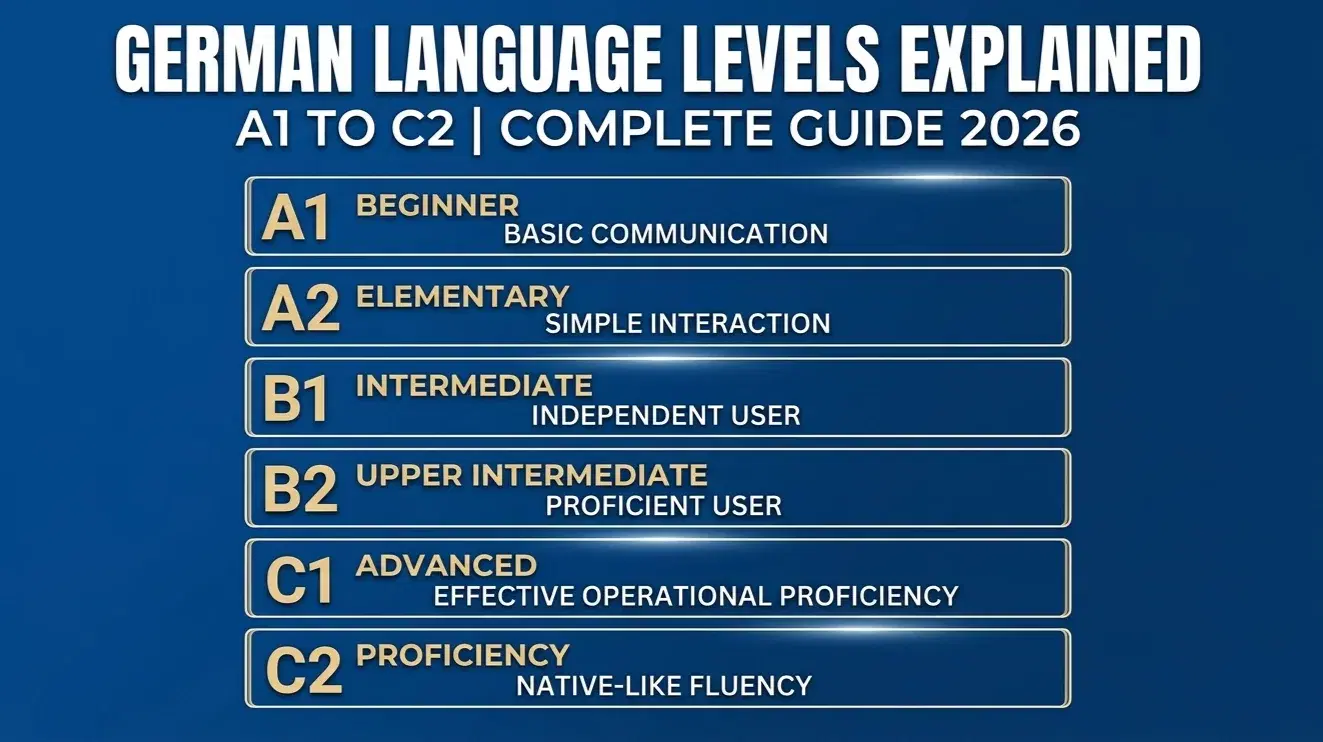
Practical implication for Sri Lankan students: start German at A1 as early as possible. For the Studienkolleg pathway, B1–B2 is needed before you can even apply. For direct Bachelor's entry, C1/DSH-2 is required. Glück Global's A1–B2 curriculum is specifically structured around these milestones.
Pathway 1: Studienkolleg - The Standard Route for Sri Lankans#
What Is Studienkolleg?
A Studienkolleg is a German university preparatory college. It is a one-year intensive programme that bridges the gap between your Sri Lankan A/L qualification and German university entrance requirements. After one year, you take the Feststellungsprüfung (FSP) - an assessment exam. Passing it grants you full university entrance ( Hochschulzugangsberechtigung).
Why Sri Lankan Students Usually Need Studienkolleg
The Sri Lankan A/L certificate is not on the direct recognition list for German universities. The Anabin database - Germany's official credential recognition tool - classifies Sri Lankan secondary qualifications as requiring Studienkolleg in most cases. Students who have completed at least one full year at a Sri Lankan university may be eligible for direct admission to some programmes, bypassing Studienkolleg.
Studienkolleg Tracks (Kurse)
| Track | Full Name | Best For |
|---|---|---|
| T-Kurs | Technisches Kurs | Engineering, Computer Science, Mathematics, Physics |
| M-Kurs | Medizinisches Kurs | Medicine, Dentistry, Pharmacy, Biology, Chemistry |
| W-Kurs | Wirtschafts-Kurs | Business, Economics, Social Sciences, Law |
| S-Kurs | Sprach-/Gesellschafts-Kurs | Humanities, Languages, Cultural Studies |
| G-Kurs | Gesundheits-Kurs | Nursing, Health Sciences |
Studienkolleg Requirements
- Completed A/L (or equivalent secondary certificate)
- German language proficiency: B1 minimum, B2 recommended
- Entrance examination (Aufnahmeprüfung) at the Studienkolleg
- Blocked account proof (€11,904)
- Valid student visa for Germany
Studienkolleg Application Timeline
- Winter Semester intake: Apply by 15 July (from abroad)
- Summer Semester intake: Apply by 15 February (from abroad)
- Allow 3–4 months for visa processing from Sri Lanka
Pathway 2: Ausbildung - Earn While You Learn#
What Is Ausbildung?
Ausbildung is Germany's dual vocational training system - and arguably the most financially attractive option for Sri Lankan students in 2026. You spend approximately 70% of your time working practically at a company or hospital, and 30% in vocational school. The entire training period lasts 2–3.5 years. The defining feature: you earn a monthly salary from day one. No tuition. No debt.
Ausbildung Training Salaries (2026)
| Sector / Profession | Year 1 (EUR/month) | Year 2 (EUR/month) | Year 3 (EUR/month) |
|---|---|---|---|
| Nursing (Pflegefachkraft) | €1,100–€1,200 | €1,150–€1,250 | €1,200–€1,300 |
| IT Specialist (Fachinformatiker) | €800–€950 | €900–€1,050 | €950–€1,100 |
| Mechatronics Technician | €850–€1,000 | €950–€1,100 | €1,000–€1,200 |
| Hotel Management (HoGa) | €700–€850 | €800–€950 | €850–€1,000 |
| Logistics Specialist | €750–€900 | €850–€1,000 | €900–€1,050 |
| Electrical Installer | €800–€950 | €900–€1,050 | €950–€1,100 |
Living costs for a shared accommodation student run €850–€1,100/month. Nursing Ausbildung students typically break even or save modestly from Year 1. Other sectors reach comfortable surplus by Year 2.
Ausbildung Requirements for Sri Lankan Students
- Completed O/L or A/L education
- German language: B1 minimum (B2 strongly recommended - vocational school is in German)
- No tuition fee; training company provides the salary
- Blocked account may be required if monthly salary is below ~€930 (most Nursing Ausbildung salaries exceed this threshold)
- Motivation letter and application to a training company ( Ausbildungsbetrieb)
Ausbildung vs University Degree - Which Is Right for You?#
| Factor | Ausbildung | University Degree |
|---|---|---|
| Duration | 2–3.5 years | 3–4 years (Bachelor's) |
| Cost to student | Zero tuition; earn a salary | Zero tuition; pay living costs yourself |
| Language requirement | B1–B2 | B2–C1 (DSH-2 for full Bachelor's) |
| Entry qualification | O/L or A/L | A/L + Studienkolleg (usually) |
| Starting salary after completion | €2,500–€3,200/month | €3,000–€5,000/month (varies by field) |
| Path to permanent residency | 4 years + 2 years employment | 4 years university + 18-month job search |
| Best for | Healthcare, trades, IT, hospitality | Engineering, IT (senior), medicine, law |
Glück Global's assessment: for Sri Lankan students from middle-income families who cannot afford 18–24 months without income, Nursing Ausbildung is the most financially intelligent pathway. For students with strong academic records who want senior engineering or IT careers, the university pathway via Studienkolleg is the better long-term strategy.
Application Timeline: Sri Lanka to German University#
| Month | Activity |
|---|---|
| Month 1–2 | Begin A1 German with Glück Global |
| Month 3 | Research universities and programmes; determine if Studienkolleg is needed |
| Month 4–10 | Complete A1 → B1/B2 German training |
| Month 8–10 | Prepare application documents (transcripts, SOP, language certificates) |
| Month 10–11 | Submit Studienkolleg or university applications (via uni-assist or direct) |
| Month 11–13 | Receive admission offer; apply for student visa at VFS Global, Colombo |
| Month 14–15 | Arrive in Germany; enrol in Studienkolleg or begin Ausbildung |
| Month 26–27 | Complete Studienkolleg (FSP exam); apply to universities |
| Month 27–31 | Begin Bachelor's degree semester 1 |
Cost Breakdown: What Does Studying in Germany Actually Cost Sri#
Lankans?
One-Time Costs (Before Departure)
| Item | Amount (EUR) |
|---|---|
| Blocked account (Sperrkonto) deposit | €11,904 |
| Blocked account service fee (Coracle/Expatrio/Fintiba) | €99–€278 |
| Visa application fee (Germany national visa) | €75 |
| Flight (Colombo to Germany, one-way) | €400–€900 |
| Initial setup costs in Germany (deposit, bedding, etc.) | €500–€1,000 |
| Total one-time costs | ~€13,000–€14,200 |
Monthly Living Costs in Germany (Student Budget, 2026)
| Expense | Monthly Cost (EUR) |
|---|---|
| Accommodation - student dorm (Wohnheim) | €250–€400 |
| Accommodation - shared flat (WG) | €350–€600 |
| Food and groceries (cooking at home) | €150–€250 |
| Statutory health insurance (public) | €110–€130 |
| Public transport (semester ticket included in many cases) | €0–€63 |
| Internet and mobile phone | €15–€40 |
| Books, stationery, university materials | €30–€50 |
| Leisure and personal | €80–€150 |
| Total (shared flat, conservative estimate) | €935–€1,283 |
The German government sets the blocked account requirement at €11,904 per year (€992/month) for 2026 - unchanged from 2025. Affordable cities like Leipzig, Dresden, and Magdeburg allow students to live well within this budget.
The Blocked Account Explained#
A blocked account (Sperrkonto) is a special bank account into which you deposit €11,904 before your visa application. Once in Germany, you withdraw €992 per month as your living allowance. It is your money - not a fee.
- Coracle - €99 setup fee
- Expatrio - €149 setup fee
- Fintiba - €278 setup fee
All three providers can be set up entirely online from Sri Lanka. No German bank account is required to open one.
Scholarships Available to Sri Lankan Students in Germany#
| Scholarship | Provider | Value | Eligibility |
|---|---|---|---|
| DAAD Scholarship | German Academic Exchange Service | Full living stipend + travel allowance | Academic excellence; varies by programme |
| Deutschlandstipendium | Individual German universities | €300/month | Top 25% of applicants at participating universities |
| Erasmus+ | EU programme | Partial funding | Exchange students from eligible institutions |
| Friedrich Ebert / Konrad Adenauer Stiftung | German political foundations | Full support | Political/social engagement + academic merit |
| Heinrich Böll Foundation | German foundation | Full stipend | Social and environmental commitment |
| Sri Lanka–Germany bilateral scholarships | DAAD country programme | Varies | Sri Lankan applicants specifically |
Glück Global helps students identify and apply for scholarships as part of the Platinum plan. DAAD applications require strong German proficiency (B2+) and usually a completed application to a German university or programme.
How Glück Global's 57+ Admissions Track Record Helps You#
Glück Global has secured 57+ university admissions for Sri Lankan students, a track record built through:
- Expert pathway assessment - not every Sri Lankan student needs Studienkolleg. Some A/L students with one year of local university study qualify for direct admission. Glück Global reviews each student's qualifications against the Anabin database to determine the fastest legitimate route - saving 1 full year where direct admission is applicable.
- ** German language training calibrated to academic deadlines ** - university application deadlines are fixed (15 July for Winter Semester; 15 February for Summer Semester). Glück Global's course schedule is designed to get students to B1/B2 in time to apply for their target intake - not “whenever they finish.”
- Document preparation and uni-assist guidance - German university applications frequently go through uni-assist, a central processing platform. Glück Global prepares and reviews every document before submission: transcript formatting, certified translation verification, SOP review, and motivation letter guidance.
- Employer and Ausbildung company matching - for students choosing the Ausbildung route, Glück Global's 95% placement rate applies. The company matches Sri Lankan students with training companies across nursing, IT, hospitality, and trades, providing signed training contracts before the visa application.
- Post-arrival academic support - the Bürstadt (Germany) office supports newly arrived students with Studienkolleg enrolment, accommodation transitions, health insurance registration, and Feststellungsprüfung (FSP) preparation.
Ready to begin your Germany study journey? Book your free pathway assessment with Glück Global →
Frequently Asked Questions#
Is education really free in Germany for Sri Lankan students?
Public universities in Germany charge no tuition. Sri Lankan students pay only the semester contribution of €100–€400 per semester (€200–€800 per year). Private universities charge fees, but Glück Global's university pathway focuses exclusively on tuition-free public institutions.
Do I need to know German to study in Germany?
For most Bachelor's programmes: yes, C1/DSH-2 German is required. For Studienkolleg entry: B1–B2. For English-taught Master's programmes: your English proficiency suffices, though B1–B2 German is strongly recommended for daily life. For Ausbildung: B1 entry, B2 completion.
What is the Studienkolleg and do I need it as a Sri Lankan student?
Studienkolleg is a one-year university preparatory programme required by most Sri Lankan students because the Sri Lankan A/L is not directly recognised for German university admission. Students who have completed at least one year at a Sri Lankan university may qualify for direct university admission in some programmes.
How much money do I need to show for a German student visa?
You must deposit €11,904 into a blocked account ( Sperrkonto) - equivalent to €992/month for 12 months. This is your own money, released monthly after you arrive. Additional funds of €200–€500 are recommended to cover setup costs.
Can I work while studying in Germany?
Yes. International students may work up to 120 full days or 240 half-days per year. At Germany's minimum wage (€12.82/hour in 2026), working 20 hours per week during term generates approximately €450–€500/month - enough to cover food and transport.
What is the difference between Ausbildung and a university degree?
Ausbildung is Germany's dual vocational training system: you work at a company and attend vocational school simultaneously, earning €800–€1,300/month throughout the 2–3.5 year programme. It leads to a German state-recognised vocational qualification - not a university degree - but is highly valued by German employers and leads to full employment immediately upon graduation.
What scholarships are available for Sri Lankan students in Germany?
The DAAD (German Academic Exchange Service) is the primary scholarship provider and offers several programmes specifically available to Sri Lankan applicants. The Deutschlandstipendium provides €300/month at participating universities. Glück Global's Platinum plan includes scholarship application guidance.
Which German cities are best for Sri Lankan students on a budget?
Leipzig, Dresden, Magdeburg, Halle, and Chemnitz offer the lowest living costs in Germany. Students in these cities routinely live within the €992 blocked account monthly release. Munich and Frankfurt are significantly more expensive but offer larger job markets post-graduation.
What happens after I finish my degree in Germany?
After completing a German degree, you receive an 18-month job search visa (Aufenthaltserlaubnis zur Arbeitssuche). You can work in any field during this period. Most Sri Lankan graduates in engineering, IT, and healthcare secure employment before graduation. After 4 years of skilled employment, permanent residency ( Niederlassungserlaubnis) becomes possible.